












A dream carved in stone and water.
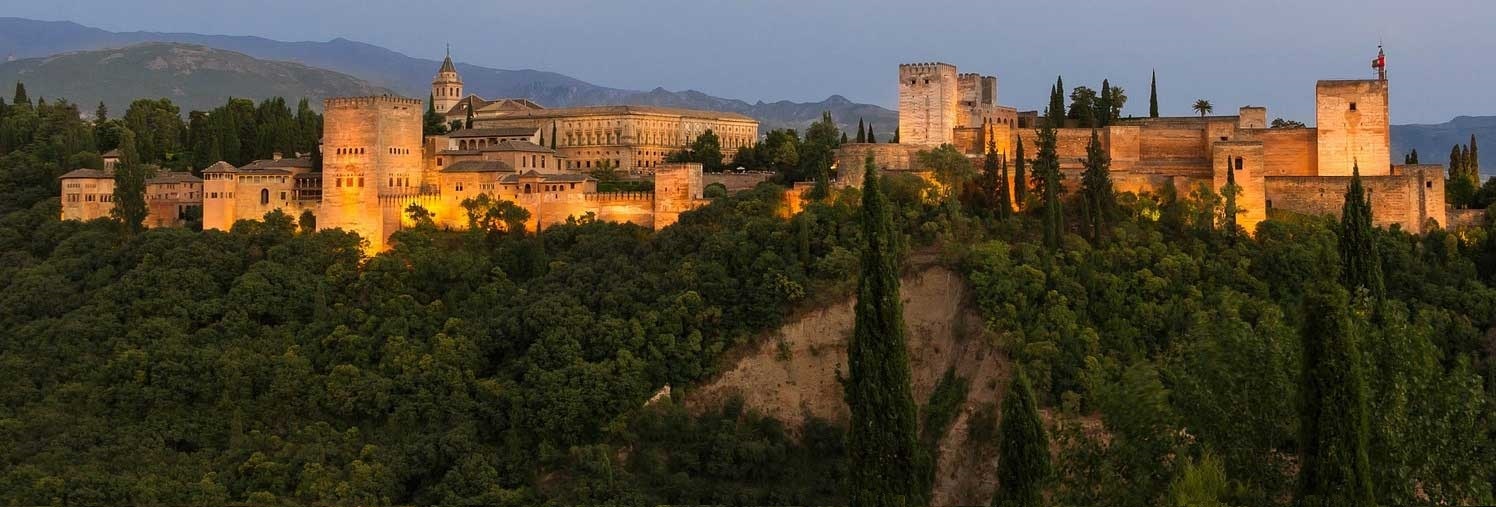 * Panoramic view of the Alhambra and Generalife at sunset, Granada
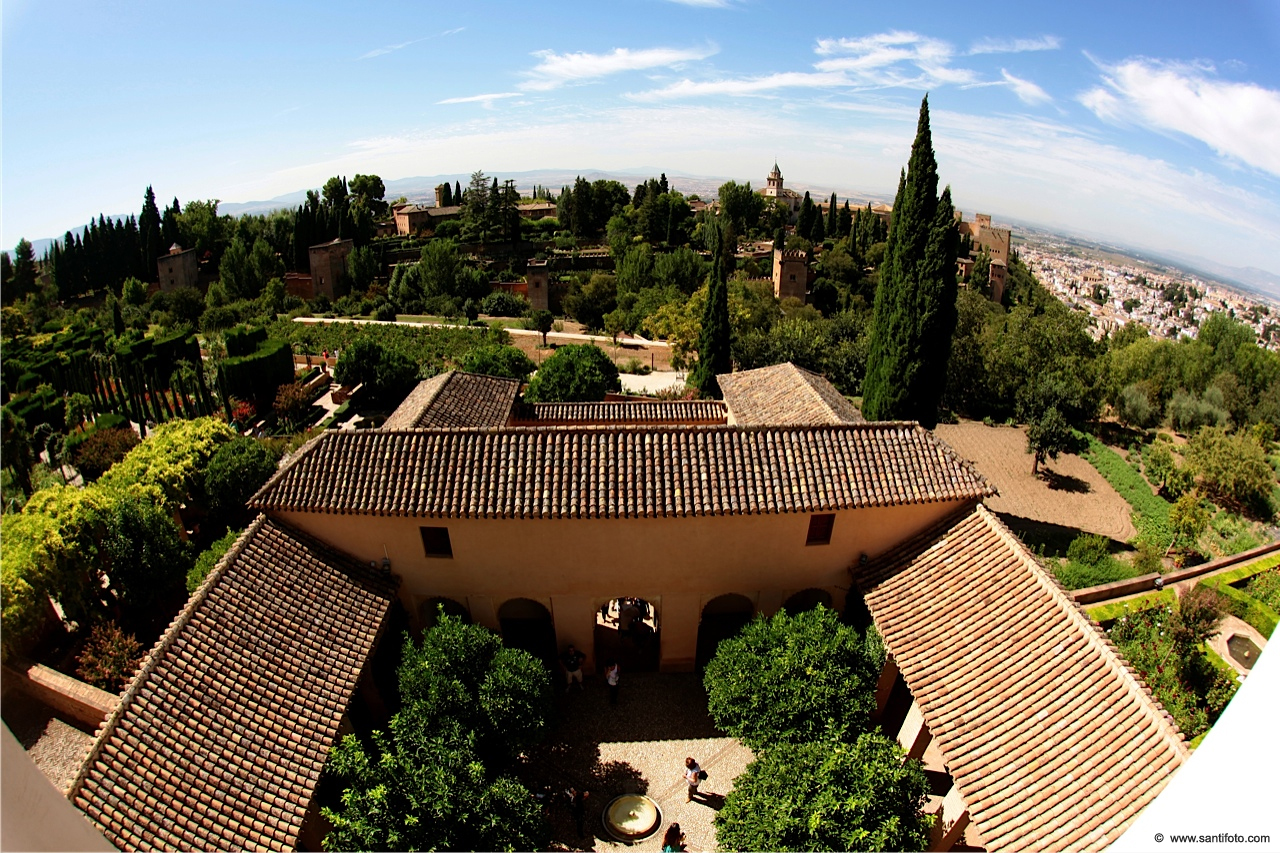
The Alhambra, located in the city of Granada in the region of Andalusia, Spain, is a palatial city of the Andalusian era. Perched on a hilltop commanding the city below, it is an all-powerful and ever-present landmark. Its imposing silhouette can be seen from virtually anywhere in Granada - majestic, watchful, and timeless. This palace complex and fortress - complete with its own Alcázar and defensive walls - served as the royal residence of the Nasrid Kingdom.
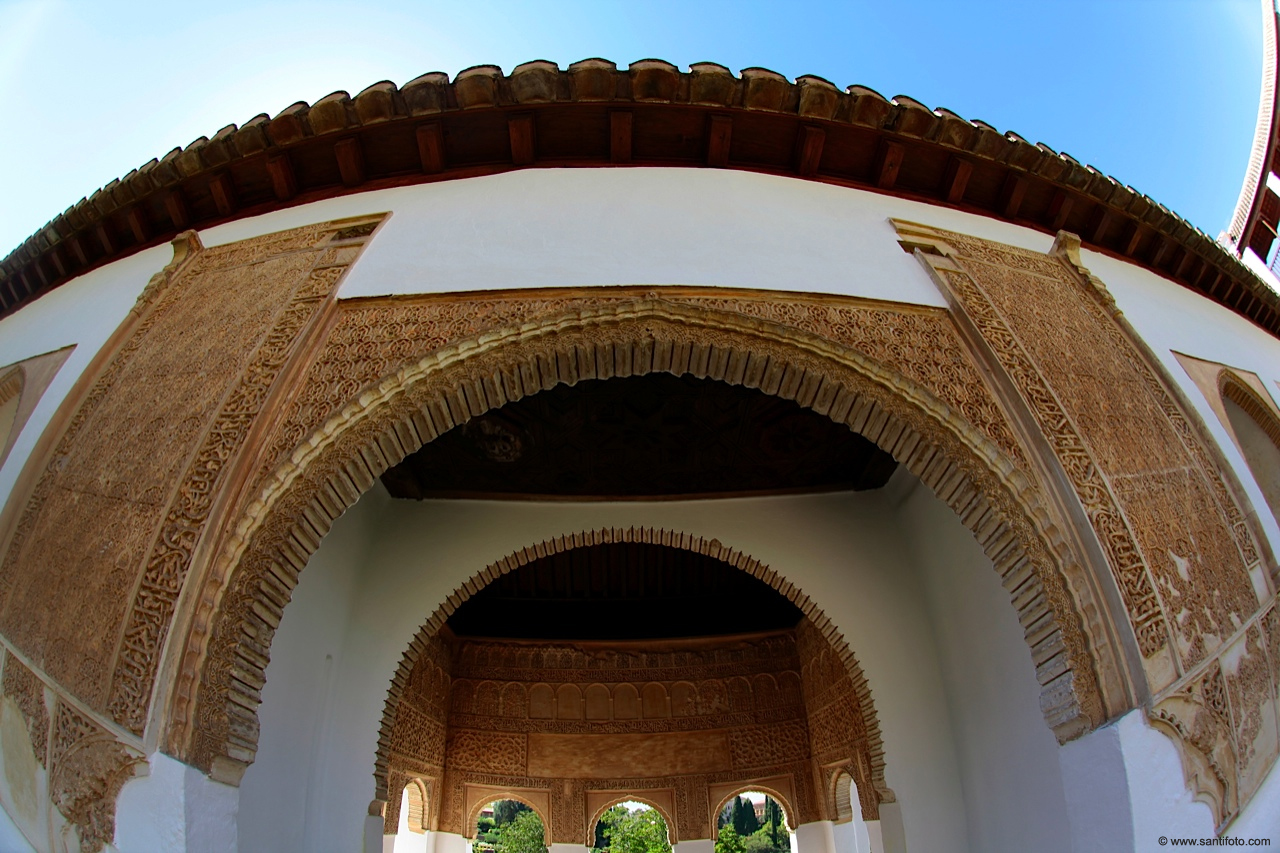
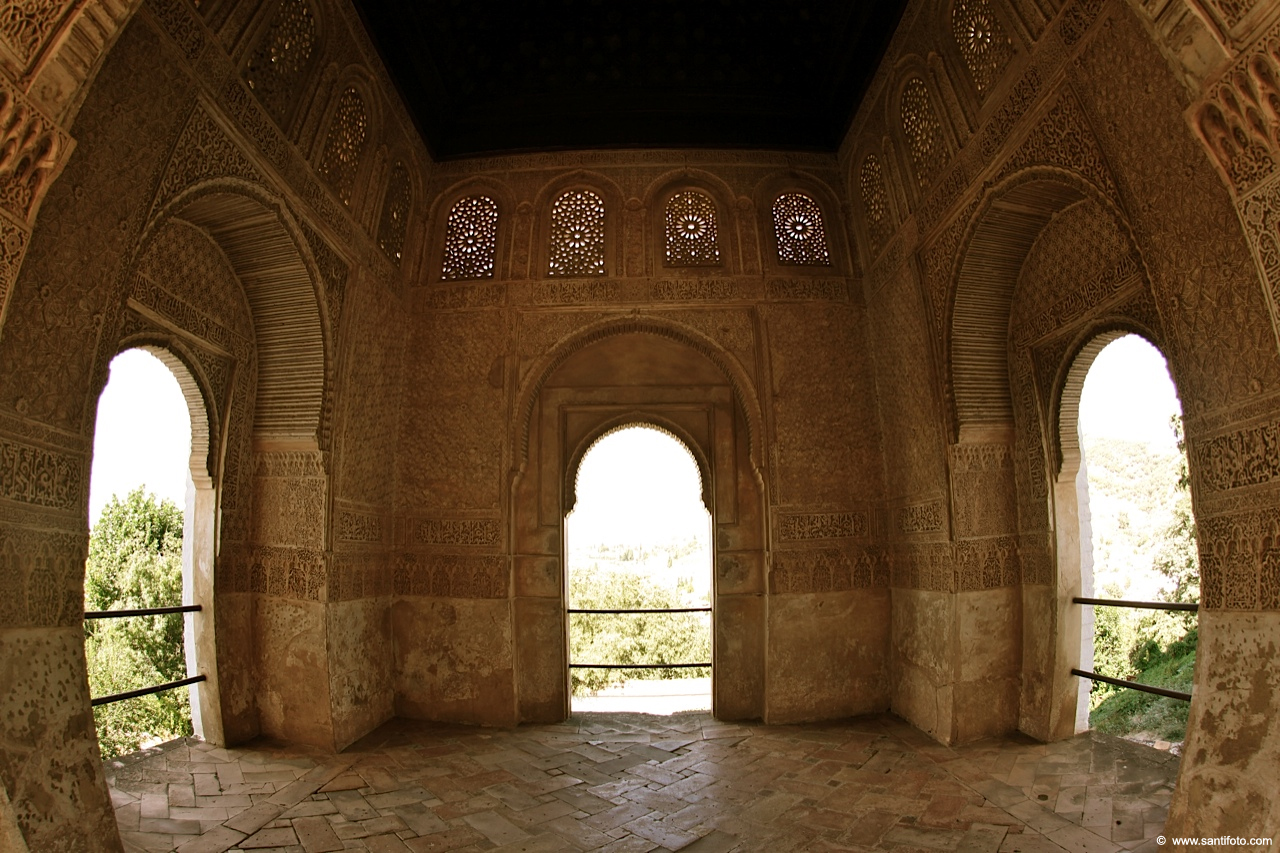
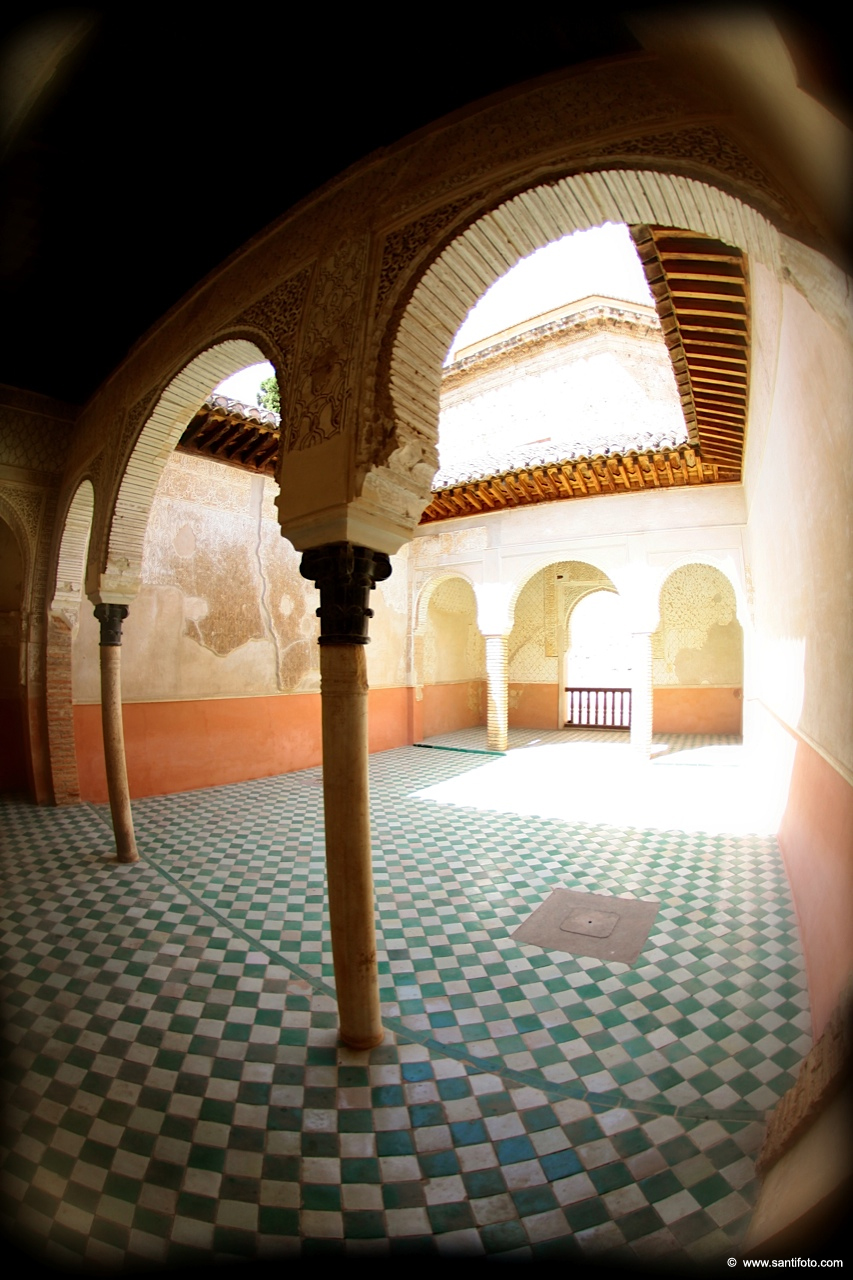
Its most celebrated feature is its interior, whose rich and intricate decoration stands among the supreme achievements of Islamic art in the world - making it the most visited monument in Spain. Advance ticket purchase is strongly recommended to guarantee availability.
Here you can enjoy photos and videos of the Alhambra and Generalife.
Origin of the name
In Arabic, Alhambra is "Al Hamra" (The Red One). Etymologically, the word derives from "al Qal'at al-hamra" (The Red Castle). In its evolution into Spanish, a "b" was inserted between the "m" and the "r" - as in the word "alfombra" (carpet), which in classical Arabic carried the meaning of "redness", written as "humrah".
This is only one version of the name's origin. Other scholars argue that during the Andalusian period the Alhambra was lime-washed and appeared white.
According to another theory, the name "the Red One" came from its construction, which was carried out at night - and when seen from a distance in the darkness, the light of the torches made it glow red. Other authors maintain that "Alhambra" is simply the feminine form of the name of its founder, Abu Al-Ahmar, which in Arabic means "the Red One" - so named because of his red beard.
History
The Alhambra is a walled city (medina) that occupies most of the La Sabika hill. The city of Granada had its own separate system of walls, meaning the Alhambra could function independently. Within its walls, the complex contained all the services needed by its population: a royal palace, mosques, schools, workshops, and more.
In 1238, Mohamed Ben Nazar (or Nasr) - known as Al-Ahmar, "The Red One", for his red beard - entered Granada through the Puerta de Elvira to take possession of the Palace of the Gallo del Viento. When he entered triumphantly, the people greeted him with the cry "Welcome, the conqueror by the grace of Allah." He replied: "Only Allah conquers." This became the motto of the Nasrid dynasty and can be found inscribed throughout the Alhambra. Ben Al-Ahmar built the first core of the palace. His son Mohamed II, who was a friend of Alfonso X the Wise, fortified it.
The Granadan style of the Alhambra reached its peak in the mid-14th century under Yusuf I, who built the Tower of Comares, and Mohamed V, who would construct the Court of the Lions.
In 1492, with the conquest of Granada by the Catholic Monarchs, the Alhambra became a royal palace. The Count of Tendilla, of the Mendoza family, was the first Christian governor of the Alhambra. The chronicler Hernando del Pulgar recorded: the Count of Tendilla and the Grand Commander of León, Gutierre de Cárdenas, received the keys of Granada from Ferdinand the Catholic, entered the Alhambra, and raised the cross and the royal banner above the Tower of Comares.
When the Catholic Monarchs, Isabella and Ferdinand, conquered the Kingdom of Granada, they expelled its king, Boabdil, who wept at having lost what he called "the earthly paradise." As he rode away towards the coast, he paused to look back at his beloved city one last time - and could not hold back his tears. His mother, witnessing this, is said to have told him: "Weep like a woman for what you could not defend like a man."
On the road to the Granada coast there is a mountain pass known as "El Suspiro del Moro" (The Moor's Sigh) - a name that comes from this very legend. From this point the entire city and the Alhambra can be seen in the distance, and it is here, according to tradition, that Boabdil stopped to gaze upon his lost kingdom for the last time.
UNESCO
The UNESCO World Heritage Committee declared the Alhambra and Generalife of Granada a Cultural Heritage of Humanity on 2 November 1984. Five years later, the Albaicín quarter (Al Albayzín) - the ancient medieval Muslim city - received the same designation as an extension of the original declaration.
The areas of the Alhambra:
The Alhambra monument is made up of distinct zones or enclosures, each of which is further divided into rooms, halls, and buildings.
Below we describe each of them in the following order.
.JPG) * View of the city of Granada with the Alhambra and Sierra Nevada in the background
* View of the city of Granada with the Alhambra and Sierra Nevada in the background
THE ALCAZABA
The Alcazaba was the military zone - the centre of defence and surveillance of the complex - and as such it is the oldest part of the Alhambra. The earliest Arab constructions date from the Caliphate period in the 11th century, later expanded when Granada became the capital of one of the Taifa kingdoms.
Its principal elements are:
- Torre del Cubo Terrace:
A semicircular tower built around 1586 on the site of an earlier Islamic gate, it was hollowed out in the 20th century. Today it serves as a privileged viewpoint overlooking the Darro valley and the Albaicín quarter.
- North Wall Walkway (Adarve):
The raised patrol path that runs along the northern wall of the Alhambra. Originally serving a defensive purpose - allowing soldiers to patrol and keep watch over the Darro valley and the Albaicín - it remains one of the most historically significant walkways of the complex.
Its principal characteristics are:
- Strategic location: situated on the northern side of the fortified enclosure, between the Alcazaba (military sector) and the Nasrid Palaces.
- Panoramic views: offers some of the finest views of the Albaicín, Sacromonte, and the city of Granada.
- Defensive function: allowed guards to move rapidly along the wall and access defensive towers including the Torre del Cubo, Torre de la Vela, and Torre de la Pólvora.
- Current accessibility: the walkway can be visited as part of a guided Alcazaba itinerary.
Historical note: During the Nasrid period, this walkway formed part of the sophisticated defensive system protecting the Alhambra from external attack. Beyond its military function, it also served as a means of rapid movement between different parts of the fortress without descending to ground level.
- Plaza de Armas:
This space functioned as the centre of daily life for the garrison responsible for defending the complex. Around the square were distributed various structures - soldiers' quarters, storehouses, workshops, and cisterns - making it a small self-contained urban nucleus within the fortress. Despite its name suggesting a ceremonial or military training function, the Plaza de Armas was primarily a practical space, dedicated to the activities required to sustain the life and security of the Alhambra's defenders.
Archaeological remains of these structures are still visible today, offering a glimpse into how this space was organised during the Nasrid period. The Plaza de Armas also provides access to other key points of the Alcazaba, including the Torre de la Vela, from which some of the finest views of Granada can be enjoyed.
- Plaza de Armas Terrace:
Located at the highest point of this space within the Alcazaba, this defensive terrace allowed continuous surveillance of the western approaches to the complex, as well as the Darro valley and the Albaicín quarter on the other side of the northern wall. From this strategic position, soldiers could monitor approach routes and respond rapidly to any threat.
Today the terrace also functions as an exceptional viewpoint from which the archaeological remains of the Plaza de Armas can be appreciated, alongside the towers that form part of the walled enclosure - including the Torre de la Vela and the Torre del Homenaje.
The terrace also helps visitors understand the defensive organisation of the Alhambra and the vital role played by the Alcazaba in protecting the palace complex as a whole. Standing here, it is easy to imagine the daily life of this military enclave - in constant contact with the Granadan landscape and the history that surrounds it.
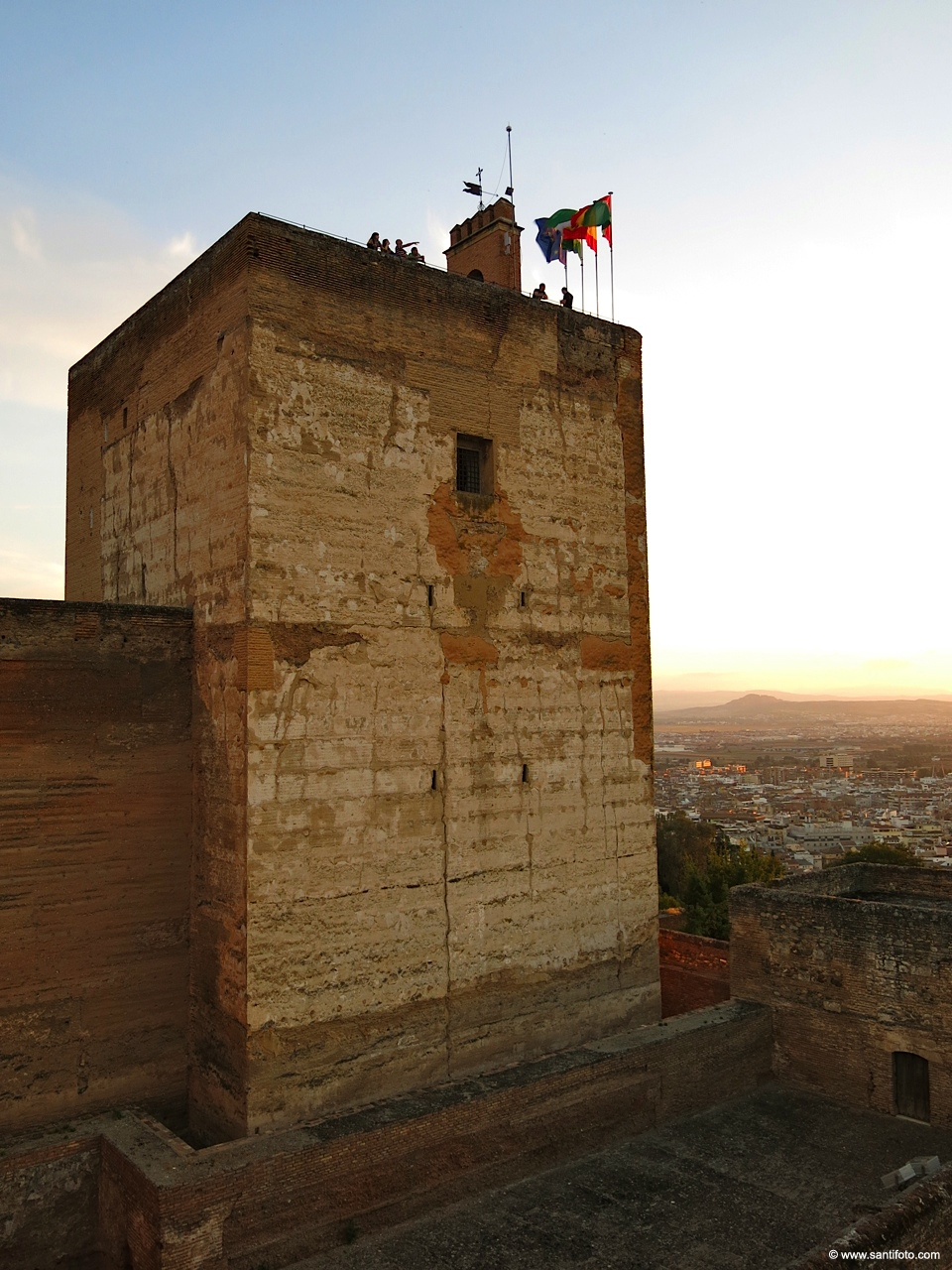
- Torre de la Vela:
The largest defensive tower in the military complex. Its name derives from the bell placed there by the Christians following the conquest of the city. One of the most iconic and visited structures of the Alhambra, it stands at the western end of the wall, commanding a sweeping panoramic view over the city of Granada, the Darro valley, the Albaicín, and the Granada plain (Vega).
The tower played an essential role in the defence of the complex. From its height, soldiers monitored access to the Alhambra and could raise the alarm in case of danger. Its position also allowed visual communication with other nearby fortresses using smoke or fire signals.
After the Christian conquest of 1492, the tower acquired additional symbolic importance. On 2 January of that year, the banner of the Catholic Monarchs was raised from its summit to announce the taking of Granada - the act that marked the end of the Reconquista. Since then, the Torre de la Vela has been the focus of a beloved local tradition: every 2 January, the public is invited to climb the tower and ring its great bell.
According to popular belief, single women who ring the bell will find a partner or marry before the year is out. Historically, the bell was also used to signal the start of the agricultural day and to warn the population of emergencies.
- Torre del Homenaje (Tower of Homage):
Rising to over 22 metres at the highest point of the fortress and with six internal floors, the uppermost level is believed to have served as the military governor's command centre.
- Torre de los Hidalgos:
According to some sources, this tower takes its name from having served as a lookout post and refuge for members of the lesser nobility (hidalgos) who formed part of the Alhambra's military structure during the Christian period. Its solid construction served the defensive needs of the time, providing good visibility towards the exterior of the northern wall.
- Torre Quebrada (Broken Tower):
Its name derives from the severe structural deterioration it has suffered over time - its damaged appearance giving it the look of something "broken" or cracked.
Unlike the more imposing towers of the complex, the Torre Quebrada served no residential function - it was purely defensive and served as a watchtower. Its position allowed observation of the Darro valley and the Albaicín, reinforcing control of the northern wall. Like the other towers along this section of the Alhambra, it was connected to the raised patrol walkway along which soldiers moved to defend the complex.
Modest yet significant, the Torre Quebrada is one more example of the extensive and complex defensive system that protected this palatial city - where every tower, however small, played an essential role in surveillance and security.
- Torre Adarguero:
Its name derives from the "adarga" - a lightweight oval or crescent-shaped shield used primarily by cavalry in the medieval period. The tower is believed to have been connected with the storage of these shields, or perhaps with the presence of soldiers specialised in their use.
Not accessible on most standard visitor routes, its plain appearance and integration into the northern wall make it a representative example of Nasrid military architecture - designed both for defence and for rapid communication between strategic points.
- Jardín de los Adarves (Garden of the Walkways):
One of the most pleasant and picturesque corners of the Alhambra. Its greatest attraction is the viewpoint offering exceptional panoramic views over the city of Granada, the Vega plain, and Sierra Nevada. From here, the Realejo quarter and the La Sabika hill can also be seen, along with some of the Alcazaba's most impressive towers, including the Torre de la Vela.
Created in the 17th century when the fortress lost its defensive character, certain disused military areas were rehabilitated and integrated into the monumental complex's landscape circuit. Over time, the Jardín de los Adarves became a place for walking and contemplation, decorated with flowers, trimmed hedges, cypress trees, and fountains that contrast beautifully with the austerity of the surrounding walls.
Located at the lower part of the Alcazaba, alongside the southern wall, it looks out over the city of Granada from the former defensive walkway from which it takes its name.
The Jardín de los Adarves represents a harmonious fusion of the Alhambra's military heritage and the beauty of landscape design. It is an ideal place to pause, rest, and take in the historic and natural surroundings that make this complex so unique.
.jpg) * Court of the Lions, Nasrid Palaces, Alhambra - Granada, Andalusia, Spain.
* Court of the Lions, Nasrid Palaces, Alhambra - Granada, Andalusia, Spain.
THE NASRID PALACES
The Nasrid Palaces comprise the Palace of Comares - built first - and the Palace of the Lions. Constructed after the Alcazaba, the Generalife, and the Partal, they date from the first third of the 14th century. They served as the seat of administrative functions, the royal court, protocol, and private retreat.
Descending the access staircase, the following rooms are encountered in sequence:
- Mexuar:
The oldest room in the palaces. During the Arab period it served as an audience and justice hall for important cases. It had an elevated chamber enclosed by latticed screens where the sultan could listen without being seen. There were no side windows and the central part of the roof was open. At the far end lies a small oratory, from which the Albaicín can be seen - deliberately oriented differently from the wall to fulfil its religious function.
The decoration is the result of countless interventions between the 16th and 20th centuries. In Christian times, this room was used as a chapel. Beyond it lies a small courtyard with a central fountain and a chamber to the left - the Mexuar Courtyard.
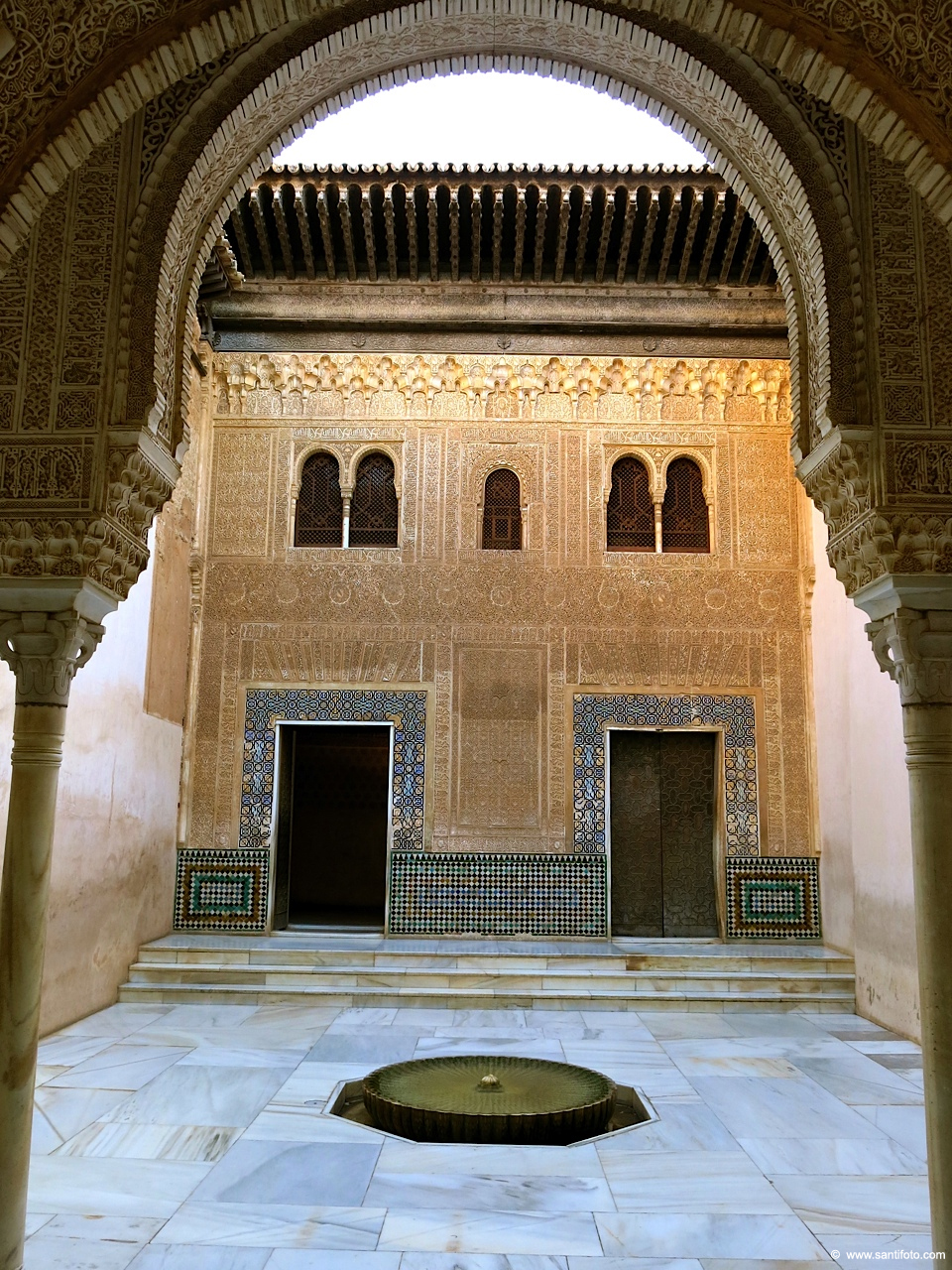
- Mexuar Courtyard or Cuarto Dorado (Golden Room):
The original use of this area in the Arab period is not known with certainty. It is known, however, that it was later adapted as a chamber for Isabel of Portugal during her stay at the Alhambra - though she never actually occupied it.
The facade of the chamber features notable capitals on its entrance arch. Inside, the most striking element is the ceiling - carved in cedarwood and decorated with pine cones and shells. Below it, windows are enclosed with latticed screens. Two rectangular doorframes are bordered by ceramic tiles. The room is decorated with Gothic paintings and the shields and emblems of the Catholic Monarchs.
There are two doors - one leading to the official palace, another leading nowhere. The door to the palace is plainer than the other: a deliberate device to confuse invaders and intruders.
- Palace of Comares:
The facade of the palace was erected on the orders of Mohamed V and inaugurated in 1370. It is an interior facade that gives little hint of the magnificence within.
- Patio de la Alberca or Patio de los Arrayanes (Court of the Myrtles):
The central courtyard of the Palace of Comares. On either side of the long reflective pool - which occupies most of the courtyard - myrtle hedges are planted. This courtyard is one of the finest expressions of a defining theme of the Alhambra: the presence of water - not merely as water, but as a mirror. The great Tower of Comares is perfectly reflected in the pool. At one end, a gallery spans the full width of the courtyard, with conversation alcoves at each side. From the gallery, one enters the antechamber.
- Sala de la Barca (Hall of the Boat):
Accessed from the north gallery of the Court of the Myrtles through a pointed muqarnas arch, the Hall of the Boat takes its name from its magnificently crafted wooden ceiling, shaped like the hull of an upturned boat. Rectangular in plan - 24 metres long by 4.35 metres wide - it appears to have been smaller originally, later extended by Mohamed V.
The room once had a semicylindrical vault that was destroyed by fire in 1890 and replaced by a faithful reproduction completed in 1964. The walls feature richly carved plasterwork bearing the Nasrid coat of arms, the word "Blessing", and the dynasty's motto: "Only Allah conquers."
The room is lined with a dados frieze, with alcoves at each end featuring tiled dados, columns supporting stilted muqarnas arches, and carved pendentives. From here, one enters the Comares Tower, presided over by the Hall of the Ambassadors.
- Tower of Comares and Hall of the Ambassadors (Salon of Comares):
The imposing Comares Tower dominates one end of the Court of the Myrtles, accessed through the Hall of the Boat. The Hall of the Ambassadors is the largest and tallest room in the entire palace. Built during the second third of the 14th century under Nasrid sultan Yusuf I, its primary function was to host the sultan's private audiences. Guests were seated in the niches set into the walls, and the sultan's throne stood here as well.
The room is square in plan - 11 metres per side and 18 metres high - with a floor originally of marble, now of clay tiles. In the centre of the room, a square bears the name of Allah inscribed on tiles. The room is extraordinarily rich in poetry - compositions praising God and the emir, along with passages from the Quran. Every centimetre of the wall is covered with decorative elements.
Along the sides of the hall are nine alcoves - three on each of the three walls - with the central alcove of the north wall reserved for the sultan. A series of windows, once closed with wooden lattices and coloured glass panels called "cumarias" (from which "Comares" derives), line the walls. Every surface is covered with plasterwork featuring shells, flowers, stars, and calligraphy. The room was polychrome: gold on the relief, light colours in the recesses. The original floor was of glazed white and blue ceramic with heraldic motifs. The walls are further decorated with Quranic verses and poems in carved plasterwork - together with the play of light and the courtly atmosphere of the original decoration, this must have made the Hall of the Ambassadors one of the most breathtaking throne rooms in the entire Islamic world. Heating was provided by braziers; lighting by oil lamps.
- The Ceiling:
One of the most captivating features of the Hall of the Ambassadors is its cubic ceiling, in which the seven heavens of Islamic cosmology are represented one above the other. The Quran states that above them lies the throne of God - and the entire ceiling is filled with stars, 105 in total. It is arguably one of the finest representations of the Universe created in the Middle Ages.
Constructed in cedarwood with inlays of different coloured woods, it forms overlapping stars arranged in multiple levels. At the highest central point is the Footstool (Escabel) upon which Allah is enthroned according to Quranic accounts. From it, geometric figures radiate outwards to divide the ceiling into seven spaces - the seven heavens descending one after another to this world. Together they form the Throne: the symbol of all creation. This symbolic use of Quranic cosmology - with its many allusions to the Footstool, the Throne, and the King who sits upon it - was clearly intended to legitimise the sovereign as the representative (caliph) of God on earth.
The throne itself stood in the centre of the hall, directly beneath the divine Footstool - a symbolism impossible to miss. But the room's significance goes further: the four diagonals of the Comares ceiling represent the four rivers of Paradise and the World Tree (Axis Mundi), which, rooted in the Footstool, extends across the entire Universe. The nine alcoves (three on each wall), together with the three omitted to create the passage to the Hall of the Blessing, are a reference to the twelve houses of the zodiac - corresponding to the role of the seventh heaven at that elevation.
We return to the Court of the Myrtles. At one end of the left side of the courtyard, a small arch leads through a passageway to the sultan's private quarters - the Harem (Haram means "private space").
- Sala de los Mocárabes (Hall of the Muqarnas):
Named after the muqarnas vault that once covered it - the present one dates from the 17th century. The walls feature plasterwork with religious inscriptions and the Nasrid dynasty's coat of arms. A muqarnas arcade leads through to:
- Patio de los Leones (Court of the Lions):
Without question the most iconic, majestic, and magical space in the entire monument. When people think of the Alhambra, they picture this courtyard - its central fountain, its porticoes, arcades, and columns.
Built in 1377 by Mohamed V, son of Yusuf I. Rectangular in plan, it is surrounded by a slender gallery of 124 white marble columns from Almería. Around it lie the sultan's and his wives' private chambers - upper floors open to the courtyard, no windows facing the exterior, but with an inner garden - in keeping with the Islamic concept of paradise.
What is now bare earth in the courtyard was once a garden. From each of the four surrounding rooms, four water channels flow towards the centre - the four rivers of Paradise. The columns are linked by delicately carved panels that allow light to filter through. Slender cylindrical shafts, rings near the top, cubic capitals bearing inscriptions. Grey lead sheets convert horizontal thrusts into vertical ones. The two pavilions that project from opposite sides of the courtyard evoke the tent of the Bedouins - square in plan, decorated with wooden domes resting on muqarnas pendentives. The eaves are 19th century. The entire gallery is covered with lacework coffered ceilings.
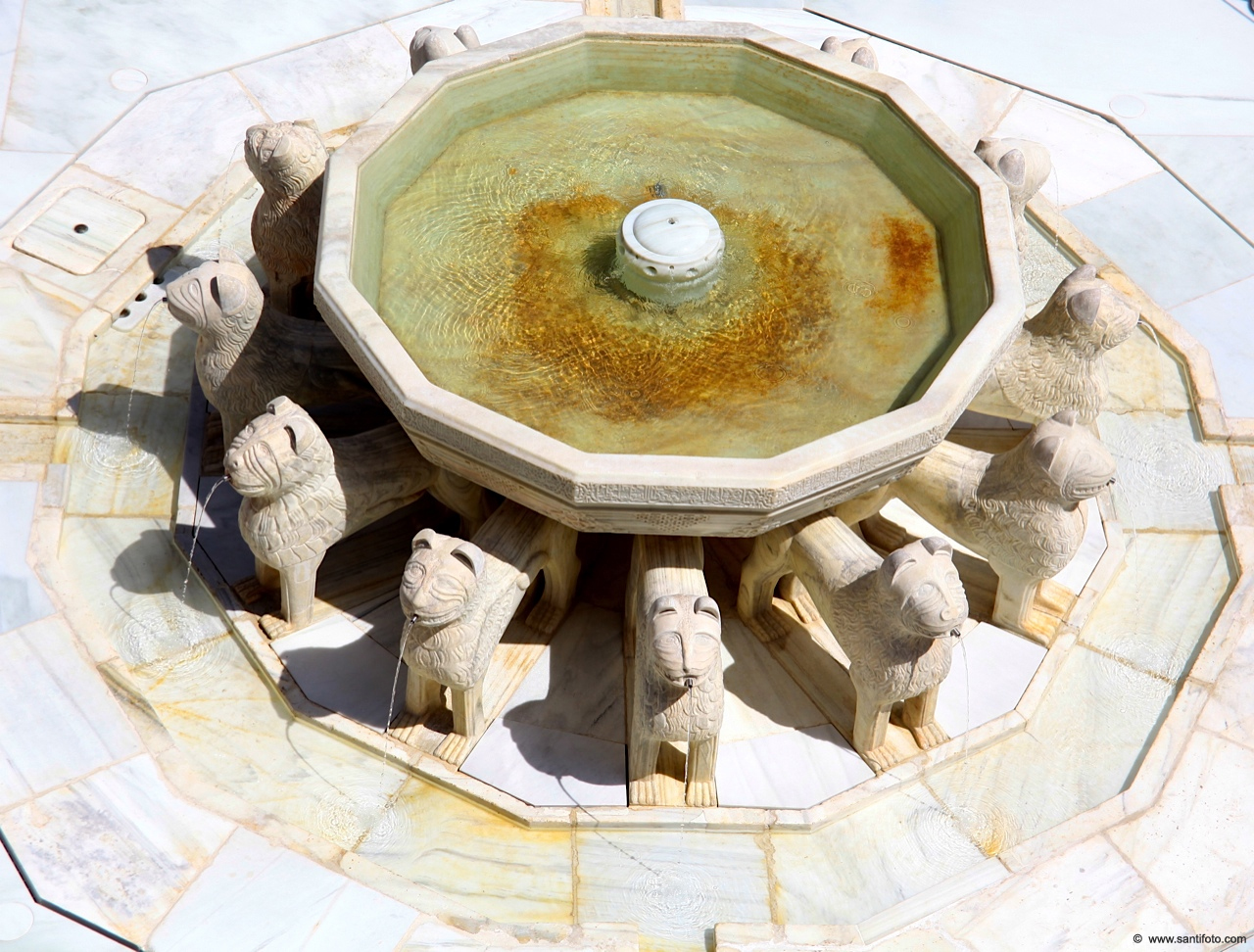
- Fountain of the Lions:
Recent studies suggest that the lions originally came from the house of the Jewish vizier and poet Yusuf Ibn Nagrela (1066). It is unclear whether they were made before his death - he was accused at the time of attempting to build a palace more magnificent than that of the king himself.
An almost exact description of this fountain was preserved by the poet Ibn Gabirol (11th century). The twelve lions represent the twelve tribes of Israel. Two of them bear a triangle on their forehead, indicating the two chosen tribes: Judah and Levi. They date from the 11th century.
The basin bears a carved inscription around its perimeter - verses by the minister and poet Ibn Zamrak, in which the fountain beautifully describes itself:
"(...) To so diaphanous a basin, a carved pearl, with borders of stilled droplets, and silver flows between the pearls, both fluid and turned white and pure. So akin are the hard and the flowing that it is hard to tell which of them moves (...)"
The Fountain of the Lions carries multiple layers of symbolism. The twelve lions have an astrological meaning - each one alludes to a zodiac sign. There is also a political or royal significance connected to King Solomon (the architect king), as an inscription on the fountain refers to him. Most importantly, the fountain evokes paradise - the source of life and the four rivers of the Garden of Eden.
The Court of the Lions now shines in its full splendour following a comprehensive restoration lasting a decade, carried out entirely by Andalusian professionals and craftspeople.
The full restoration of the Court of the Lions began in 2002 with the removal of the fourth lion - the first of the twelve sculptures to be restored. In 2007, the remaining eleven lions were removed from the courtyard for an extensive restoration process carried out in the workshops of the Alhambra and Generalife Board of Trustees, removing thick calcareous encrustations, halting biological colonisation, consolidating fractures, and removing metallic elements and harmful substances including cement.
The basin - carved from a single piece of marble - had to be restored in situ in a temporary workshop set up in the courtyard itself, due to its exceptional size. During the restoration of the fountain's hydraulic system, an archaeological excavation using full scientific methodology was carried out in the Court of the Lions for the first time, documenting and preserving all materials found.
The final phase of the project involved the laying of 250 pieces of white Macael marble (from Almería) covering a surface area of 400 square metres - restoring the courtyard to its historic appearance: the way it looked when Sultan Muhammad V used it as part of the Nasrid royal residence in the 14th century, and as it was described by the chroniclers of the time.
- Hall of the Abencerrajes:
This room was the sultan's private chamber. Being a private space, there are no exterior windows. The walls are richly decorated with original plasterwork and colours. The tile dado is 16th century, from the Sevillian ceramic workshops. The dome is decorated with muqarnas; at its centre in the floor, a small fountain once reflected the intricately decorated muqarnas ceiling above - as light entered from above, it changed throughout the day, creating an enchanting, magical effect.
- Hall of the Kings:
Occupying the entire eastern side of the courtyard and named after the painting on the vault of its central chamber, this is the longest room in the Harem, divided into three equal sections and two smaller ones that may have served as storage areas, given their position and lack of light. It was probably used for private family celebrations.
The central vault paintings depict the ten first kings of Granada from the founding of the kingdom - one of them with a red beard, likely Mohamed ben Nazar, called Al-Ahmar the Red, founder of the Nasrid dynasty.
The side vaults feature paintings of knights and ladies, executed at the end of the 14th century. There was an artistic exchange during the reign of Peter I of Castile, who requested assistance from the king of Granada to restore the Royal Alcázar of Seville. The paintings employ a highly intricate technique: Planks of wild pear wood, carefully planed and shaped into an ellipse.
Over the concave surface, wet leather is stretched and adhered with a coat of glue, fixed with small square-headed tin-coated nails to prevent oxidation. Over the leather, a layer of plaster, reed, and glue approximately 2 cm thick, painted red. Over this layer, the scenes are drawn with a stylus.
The room is internally divided by transverse arches cutting across the space perpendicularly. These arches display muqarnas on their soffits and are covered with plasterwork featuring both Nasrid and Christian symbols. The overall appearance of the room with its decorated arches is reminiscent of Almohad mosque architecture.
- Hall of the Two Sisters:
Exiting the Court of the Lions on the opposite side from the Hall of the Abencerrajes, one passes through an original marquetry door - one of the finest in the palace, now preserved in the Alhambra Museum. The name "Two Sisters" comes from the two identical white marble slabs set into the floor on either side of the central fountain - perfectly equal in size, colour, and weight, and the largest in the Alhambra. The room has a viewpoint overlooking the city and direct access to the baths.
Like the rest of the Alhambra, this room has poems inscribed on its walls. One reads: "Without equal, a radiant dome within it, with enchantments both visible and hidden (...) Never have we seen a garden so verdant, of sweeter harvest and more fragrant scent."
In each room of the Harem there are two small doors: one leading to the upper Harem, the other a latrine. There were no kitchens - cooking was done on portable stoves or outside.
- Hall of the Ajimeces and Lindaraja Viewpoint:
At the far end of the previous room stands the Lin-dar-Aixa Balcony. It once overlooked the Darro valley with views of the city beyond. The construction of the Charles V Pavilion now blocks that view, which is why the Lindaraja Garden - in the Italian style, with a Renaissance fountain and an Arab marble basin - was created. In the Lindaraja viewpoint, a poem can be read: "I am the fresh eye of this garden (...) Through me, Granada sees its throne."
- Emperor's Chambers:
The six rooms known as the Emperor's Chambers were built during the reign of Charles V, between 1528 and 1537, forming the Lindaraja Courtyard on one side and the Patio de la Reja (Grille Courtyard) on the other.
- Emperor's Room:
Built for King Charles to reside in during his honeymoon visit to Granada. In the next room there is a marble plaque in memory of the writer Washington Irving, who lived in this part of the complex while writing his Tales of the Alhambra in 1829.
- The Queen's Dressing Room (Peinador de la Reina):
An Arab tower known as the Tower of Abul-Hachach, used by the sultan for recreation and meditation. After the Christian conquest it was remodelled. The upper floor may have served as a royal dressing room, possibly used by Queen Isabella Farnese. Its structure shows Roman influences in the form of the viewpoint with its porticoed gallery and pictorial decoration.
- Patio de la Reja or Cypress Courtyard:
Accessed from the last of the Charles V chambers, this courtyard dates from the same period.
- The Partal:
The area corresponding to the palace servants' quarters.
- Tower of the Captive (Torre de la Cautiva):
A sumptuous construction by Yusuf I, it takes its name from Isabel de Solís, who was held captive here. Among its inscriptions: "In its tile dados and on its floor, there are wonders as if woven."
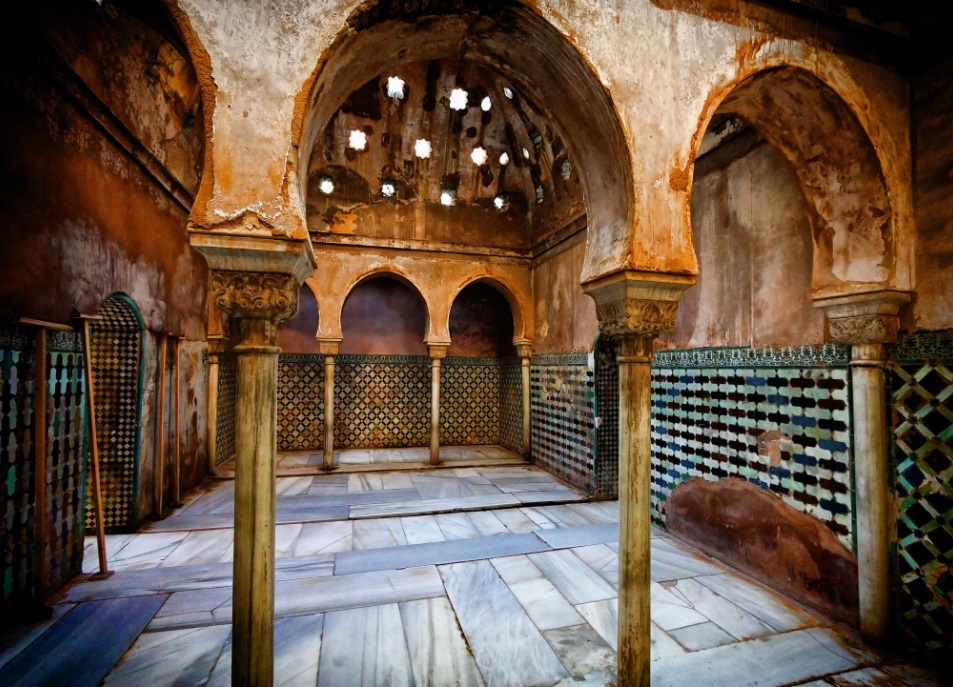
- The Baths:
The jewel of the Arab house. Bathing for Muslims is a religious obligation. The construction follows the model of the Roman baths and consists of three rooms:
Changing and rest room - a bed chamber and resting area where visitors undressed before bathing and rested afterwards. Food was sometimes brought here. In the upper gallery there were musicians and singers.
Massage room - a cooling and massage room.
Two arcaded galleries. Steam room - the smallest of the three. The vaults are pierced with star-shaped skylights, originally covered with coloured glass but not sealed, allowing steam to escape while fresh air entered.
- Tower of the Infantas:
Built in 1445, it is the best-preserved tower and a fine example of an Andalusian dwelling with all its comforts: a palace with benches at the entrance for the eunuchs, an interior courtyard with alcoves, a bent entrance, a central fountain, windows looking onto the flower gardens (in this case, the Generalife), and an upper floor for the ladies. A terrace above. The ceiling was of muqarnas, lost in an earthquake. A curious entrance vault. Residence of the sisters Zaida, Zoraida, and Zorahaida, whose story Washington Irving recounts in Tales of the Alhambra.
Other spaces include: - Palace Portico, - Gardens and promenades, - Palace of Yusuf III, - Tower Walk (Paseo de las Torres), - Torre de los Picos
%20(10).JPG) * Night panoramic view of the Alhambra and Generalife from the Albayzín quarter
* Night panoramic view of the Alhambra and Generalife from the Albayzín quarter
THE GENERALIFE GARDENS
The Generalife is the garden villa used by the Muslim kings of Granada as a place of rest, situated in the Andalusian city of Granada, Spain.
It was conceived as a rural retreat where ornamental gardens, orchards, and architecture were integrated, in the hills near the Alhambra. The origin of the name is debated. Some favour Yannat al-Arif as "Garden of the Architect", though it may have meant "The Most Exalted Garden". Such royal gardens were common in Hispano-Arabic courts.
Declared a UNESCO World Heritage Site, it was built between the 12th and 14th centuries and transformed by Abu I-Walid Isma'il. Built in the Nasrid Arab style, it stands on the northern side of the Alhambra. It consists of a group of buildings, courtyards, and gardens that make it one of the greatest attractions of Granada - and, alongside the Alhambra, one of the most remarkable examples of Muslim civil architecture in existence.
From the exterior, two pavilions can be seen to the north and south, connected by a courtyard through which water flows. Both pavilions have been substantially modified over the centuries.
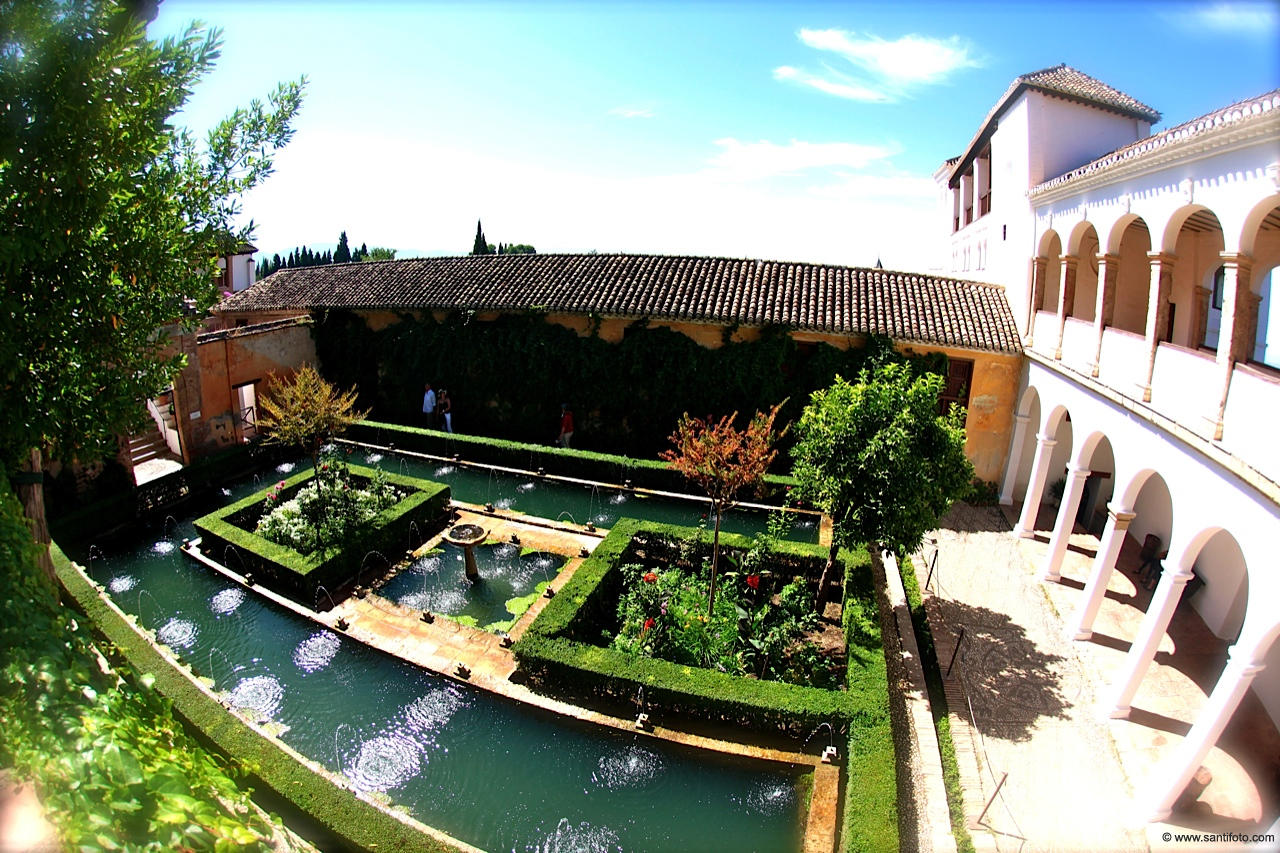
- Patio de la Acequia (Court of the Water Channel):
The first - and most emblematic - courtyard follows the Arab quadripartite garden scheme (Char-Bagh) of Persian origin, a tradition deeply rooted in Andalusia, though adapted here to the predominantly longitudinal layout imposed by the terrain and further shaped by the presence of the Royal Water Channel (Acequia Real), which carried water to the surrounding orchards and then to the Alhambra. The other arm of the cross is merely suggested by an interruption in the vegetation and a low fountain at the crossing point. The channel is flanked by two rows of water jets that cross dramatically in the air - added in the 19th century.
It is worth noting that although the Generalife is, like the Alhambra, an essentially Islamic construction, the cultural influence of Christian architectural concepts was always significant: before 1492, through constant contact with neighbouring Christian kingdoms and relative isolation from the rest of Islam, and afterwards, through the adaptation of its spaces to Western sensibilities by its various owners and inhabitants. Another example of this is the wide viewpoint opened along the courtyard in the Christian period.
- Sala Regia (Royal Hall):
At the far end of the Patio de la Acequia, beyond a five-arched portico, lies the Sala Regia, beautifully decorated with plasterwork and leading to a 14th-century viewpoint. The decoration of this hall, and of the complex as a whole, is comparatively more restrained than that of the Alhambra's palace rooms. As a rural retreat, an absence of ostentation would have been the overriding spirit. As Leopoldo Torres Balbás wrote: "In the Generalife, everything is simple and intimate. Nothing - architecture or nature shaped by human hands - seeks to astonish us with pretensions of magnificence or monumentality."
- Patio del Ciprés de la Sultana (Courtyard of the Sultana's Cypress):
From the Sala Regia, a staircase leads to a double Renaissance-style gallery, opening onto the Courtyard of the Sultana's Cypress - the focus of mystery in Granadan tradition. Legend, as told by Ginés Pérez de Hita, places here the secret meetings between Boabdil's wife and a nobleman of the Abencerrajes clan, related to the sultan. Heavily modified in the Christian period, the courtyard nevertheless retains the spirit of its former inhabitants - in what Chueca Goitia called the "characteristic invariants" of the Andalusian tradition - and the romantic charm of its fountains and lush vegetation. The courtyard dates from the late 13th to the early 14th century.
- Upper Gardens and Water Staircase:
Continuing upwards via the Lions' Staircase, one reaches the Upper Palace Gardens - passing through the Water Staircase, an ingenious device designed to delight the senses. Its primary purpose was to connect the Generalife palace with a small chapel at the top of the hill.
The sloping ascent presented a challenge that the Nasrid master builder resolved with singular skill: the staircase, interrupted by several circular landings with low fountains, has as its handrails two channels made from simple tiles and bricks, lime-washed white. Along them flows the water of the Royal Channel, rushing and irregular, producing a symphony of tranquillity and repose - humidifying the air throughout, all beneath a dense canopy of laurels.
The resulting space - shaded and cool - also served for the ablutions required before prayer, functioning as the sahn (forecourt) that every mosque requires. The staircase is a masterclass in architectural ingenuity: turning necessity into virtue with the humblest of materials.
OTHER AREAS
- Palace of Charles V:
Named after the Emperor Charles, for whom it was built as a residence - though there is no record that he ever actually lived there. Located beside the Nasrid Palace of Comares, it presents a striking contrast to the Islamic architecture surrounding it. Square in plan with a circular courtyard, it was designed by Pedro Machuca.
Remarkable for its date of construction (1527) - very early for a style firmly within Mannerism: Doric columns on the first floor, Ionic on the second, and a frieze with bull heads (bucrania) of Graeco-Roman tradition. In several respects it repeats or anticipates certain architectural solutions of Italian Mannerism - explained by Machuca's time in Italy and his ability to develop certain features of the emerging Mannerist style with his own inventive flair.
Construction was interrupted in the 17th century and not completed until the 20th. The facade is entirely Renaissance in character. The lower section in the Tuscan style with rustication; the upper with Baroque decorative elements. Above the main entrance, two winged female figures recline in the pediment. Above, three medallions framed in green marble. On the sides, scenes of Hercules. The iron rings on the lower section are purely decorative.
- Convent of San Francisco:
Now a Parador (state-run luxury hotel). It was originally a noble Andalusian house. After the conquest it was given to the Franciscan order, making it the first convent in Granada. The Andalusian courtyard is well preserved, with muqarnas, a latticed balcony, and a cistern.
- Secano or Upper Alhambra:
Currently under study through archaeological excavations. This was the neighbourhood of the Andalusian people and nobility, including the ruins of the Palace of the Abencerrajes.
- Torre de los Siete Suelos (Tower of the Seven Floors):
Only four floors have been found (beneath ground level). Famous for featuring in several of Washington Irving's Tales of the Alhambra. Legend has it that Boabdil left the palace through this very tower.
%20(7).JPG) * The Alhambra and Generalife above the city of Granada
* The Alhambra and Generalife above the city of Granada
.JPG)
 (6).JPG)
 (8).JPG)
 (4).JPG)
 (2).JPG)
 (9).JPG)
.jpg)
.jpg)
.jpg)
.jpg)
.jpg)
.jpg)
.jpg)
.jpg)
.jpg)
 (4).JPG)
 (3).JPG)
 (1).jpg)
.jpg)
.jpg)
.jpg)
.jpg)
.jpg)
 (4).JPG)
 (5).JPG)
 (6).JPG)
 (2).jpg)
 (4).jpg)
 (1).jpg)
 (3).jpg)