












* The following is a transcript of the video documentary.
The Alhambra and the Nasrid Kingdom of Granada
The Alhambra: A Jewel at the Feet of the Sierra Nevada
At the feet of the Sierra Nevada, overlooking the vast plains of the Vega de Granada, the Alhambra stands sublime upon its hill. Here, the Nasrid dynasty wrote the final chapter of the history of Muslim Al-Andalus.
High above the city of Granada, the Nasrids constructed a palatine city unique in the world.
In 1492, the Catholic Monarchs conquered the last Muslim kingdom, immortalizing the marks of their victory within the Alhambra. Centuries later, the Nasrid buildings fell into neglect; it was only in the 19th century that the Romantics fascinated Europe and America with their tales, and restoration efforts rescued the palaces for future generations.
Today, it stands as one of the most visited cultural landmarks in the world; a place where history still lives.
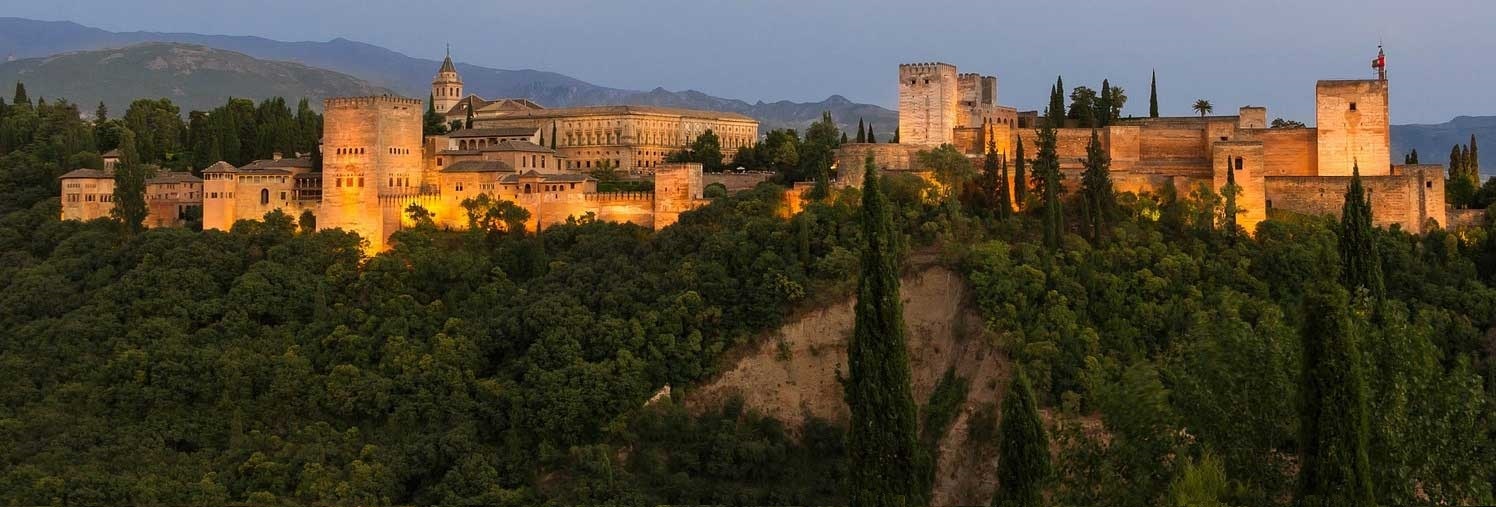 * The Alhambra and Generalife of Granada as seen from the San Nicolás viewpoint.
The Origins of the Nasrid Kingdom
The Muslim conquest of the Iberian Peninsula began in the year 711. Barely 7,000 men crossed from North Africa to Gibraltar, defeating the prevailing Western kingdoms.
The new kingdom of Al-Andalus stretched from the Atlantic to the Pyrenees. For a long time, Córdoba served as the capital, until Islamic Andalusia was divided into small kingdoms (Taifas) during the 11th and 12th centuries.
With the onset of the Christian Reconquista, the Muslims lost much of their territory. The days of Islam in the peninsula seemed numbered, until Mohamed Ibn Nasr managed to consolidate power amidst the chaos.
During Ramadan in 1238, Muhammad Ibn Nasr, also known as Al-Ahmar ("the Red"), entered the city of Granada in triumph. Proclaimed as Mohamed I, the first Sultan of the Emirate of Granada, he founded the Nasrid Kingdom, establishing Granada as his capital. This followed his successful consolidation of Almería and Málaga. Through a masterstroke of strategy, Mohamed allied with his enemy; Granada thus became a vassal state to Ferdinand III, the Christian King of Castile.
In this way, Mohamed Ibn Nasr became the founder of a dynasty. For two and a half centuries, the Nasrids would rule the new Emirate.
For strategic reasons, the establishment of the new kingdom required the construction of a modern, strong, and powerful fortress—unaware that it would eventually become a recognized wonder of the world.
"Al-Hamra" (meaning "The Red One" in Arabic).
As early as the 9th century, Arabic sources had mentioned a red castle, so named for the hue of the rammed-earth (tapial) adobe of its walls.
Mohamed ordered the construction of the Alcazaba, the citadel, upon the foundations of these ancient fortifications. The citadel’s layout began as a simple triangle; from there, an impressive complex developed over 200 years, nestled harmoniously between the foothills of the Sierra Nevada and the Darro and Genil rivers.
“The citadel of the Alhambra, a royal court, crowning it with its white battlements, its soaring towers, and its elevated palaces that dazzle the eye and astound the mind. Not a single part of it is without orchards, cármenes, or gardens.” These lines were penned by the famous Ibn al-Khatib, poet of the Nasrid court.
The Palaces of the Alhambra and Life in the Nasrid Court
The Alhambra is simultaneously a fortress, a sultan's palace, and a city, protected by an outer ring of fortified walls and towers. Between these walls lived palace guards and soldiers, housed in small dwellings right next to the Hammam. With its machicolations, intricate battlements, and soaring towers, the citadel was impregnable; however, the stability of the Nasrid reign relied more on skillful diplomacy—a constant and precise balance between conquest and strategic pacts.
Twenty-four sultans directed the destiny of the Emirate over the centuries. Among them, the most renowned rulers of the 14th century constructed exquisite chambers for both personal and official use: the Nasrid Palaces. Seen from the outside, the Alhambra appears as a series of austere, bare walls; its true wealth is revealed only from within.
The Alhambra never ceases to surprise. One may be marveled by the perspective from a viewpoint, intrigued by the functional ingenuity of a space, or stunned by the sophistication of certain decorations. These details possess an immense delicacy and exquisiteness; as a whole, they represent a brilliant mastery of harmonious design.
The Main Palaces
The Nasrid Palaces consist of three independent yet connected areas: the Mexuar (Maswar), the Comares Palace, and the Palace of the Lions. Although they form a unified complex, each palace was commissioned by a specific sultan.
One of the oldest sections is the "Maswar" palace, which served as an audience and council chamber. The central floor was built by order of Isma'il I, the fifth Sultan of Granada. Here, he listened to his ministers and administered justice. انه مشوره لله (It is the counsel of God). The verses of Ibn al-Khatib illustrate the room's original function: "Congratulations on your joyous construction; it was made for days of counsel and of giving. How beautiful is its dome, higher than the heavens, surpassing the gaze of the spectator."
The wooden dome with stained glass has disappeared, but one can imagine its former beauty by observing the ceiling of the Lindaraja Mirador.
Regarding the Palace of the Lions, chronicles provide contradictory accounts of Sultan Isma'il I in the year 1319. The Spanish princes Pedro and Juan attempted to conquer Granada, losing their lives at the Battle of Sierra Elvira alongside many Christian knights. Some sources suggest Isma'il ordered Prince Juan's body to be sent to Córdoba with an honorary escort; however, other Arabic sources claim Juan's body was hung from an Alhambra tower—a classic example of medieval propaganda warfare.
Behind a narrow passage in the inner courtyard of the Golden Room, a small door grants entry to the courtyard one by one—a security measure for a space that transitioned between semi-public and private. The façade of the Comares Palace served as a backdrop for splendid court ceremonies. In the center, in a privileged position, sat the Sultan; his throne was a luxurious portable chair, a true staging of power.
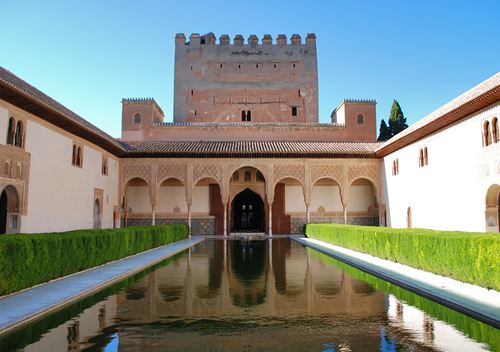
Just alongside is an intricate zigzag passage leading to the heart of the Comares Palace, revealing the clear view of the Court of the Myrtles (Patio de los Arrayanes) with its central pool—the very hub of courtly life.
The Comares Palace was built by Isma'il’s son, Yusuf I.
We arrive at the Hall of the Boat (Sala de la Barca), constructed as a vestibule before the Sultan's pavilion. The Throne Room represents the center of power, both divine and earthly. It is cited as one of the masterpieces of Nasrid architecture.
One of the nine alcoves breaks the decorative proportion: the Sultan's chamber. According to Nasrid custom, rooms changed function frequently; even official halls were used for personal purposes.
Here, one of the most remarkable interior spaces in the entire Alhambra was created. Its ceilings are a masterpiece of Islamic carpentry. The wooden construction recreates the heavens. According to the Quran, a believer's soul must traverse seven heavens; the eighth represents paradise, the Throne of God, depicted here as a small muqarnas dome. The points of the ceiling imitate the roots of the Tree of Paradise.
Under this sky, Yusuf directed government affairs, as narrated in the verses inscribed in the alcove. The final part of the poem is particularly interesting, as it clearly states that this was the site of Yusuf I's throne: "My lord Yusuf made me the throne of the kingdom, protecting me with light, the seat, and the divine throne." These three Quranic concepts allude to God's enthronement above the seven heavens.
The Baths and the Hammam
Located right next door is the Hammam, an essential element of the palaces. At its peak, the Alhambra had more than a dozen. Islam has always placed great importance on hygiene and ritual cleanliness; however, for guests, visiting the baths was also linked to pleasure and social interaction.
The Hall of the Beds served as both a dressing room and a relaxation area. The colors of the decorative elements, columns, and wooden ceilings are striking; however, only the columns, fountains, and floors are original. The plasterwork was repainted in the 19th century with vibrant colors, providing an idea of the polychrome appearance the Alhambra’s interiors once had. Walls were adorned in various colors—primarily black, red, and blue—alongside Quranic texts covered in gold leaf.
The Hammam was divided into several zones: a massage room, a steam room, basins with hot and cold water, and the boiler. Steam levels were regulated by adjusting the skylights in the ceiling. To heat the rooms, ducts were installed beneath the marble floors, originating from a central heating boiler. Thick-soled shoes were necessary to walk across the heated floors.
The Zenith of the Nasrid Kingdom
The Nasrid Kingdom reached its economic and cultural peak in the mid-14th century. Prominent intellectuals from across the Islamic world were invited as guests to Granada. However, court life was anything but peaceful; it was defined by constant plots, betrayals, and assassinations, even among close relatives.
Few Alhambra monarchs died of natural causes. Yusuf I was not one of them. On October 19, 1354, while he was praying, a madman stabbed him. Yusuf cried out, interrupting the prayer, but help arrived too late and the Sultan died shortly after. The assassin was later executed by the people.
“Perform your prayer; be not among the heedless.” An inscription from the seventh surah of the Quran calls the faithful to prayer. The Mihrab shows the direction to Mecca, and these prayer niches can be found throughout many parts of the palaces.
Everything that happened at court was connected to God. The prayer room invites meditation and opens toward the city—a rare feature for a mosque. The views of the landscape and nature make the grandeur of creation even more present.
The Reign of Mohamed V
On the same day as Yusuf's assassination, his son Mohamed V ascended the throne, becoming one of the Emirate's greatest sultans. During his rule, Granada became the center of Islamic culture in the West, but the throne was highly coveted. Mohamed had been in power for five years when a conspiracy was organized against him during Ramadan. The Sultan was resting at the Generalife, the summer residence, and barely had time to flee. The conspirators proclaimed his brother as the new sovereign, and Mohamed fled to North Africa.
How could he regain his lost power? Help came from none other than the Christian King Peter I of Castile (Peter the Cruel), who killed the leader of the conspiracy with his own hands. Only three years later, in 1362, Mohamed returned to his homeland, but the Christian king's support came at a high price. Peter knew well how to use the Nasrids' internal rivalries for his own interest. Mohamed's knights were frequently forced into war on Peter's behalf.
Mohamed's second term constituted a short period of peace after his return. He ordered the construction of the Palace of the Lions with a splendor never seen before. Here, the roofs resemble tents placed around an oasis; the lion fountains and porticos resemble palm trees. Once again, the interplay between open and closed spaces created a majestic stage for musical performances and festivals. The four main rooms offered ample space for entertainment beyond the rigors of protocol. Three vaults crown the Hall of the Kings, adorned with 14th-century paintings of court scenes.
The Court Poets
Figurative representation is quite unusual in Islamic art; however, the Nasrids were merchants who maintained close ties with traders from Genoa, Pisa, and Venice, participating in cultural exchange as well as commerce. The paintings may have been commissioned from Italian or French artists. They depict scenes likely set in the gardens and halls of the Alhambra: important court figures sitting on cushions, chatting animatedly with rugs spread before them and swords hanging firmly from their belts.
A luxurious wooden door opens—a masterpiece of carpentry. The entrance leads to the palace's main hall, the Qubba, a square room also known as the Hall of the Two Sisters. Private quarters were located on the upper floor. From there, the Sultans' wives could follow court life through latticework (celosías), as the harem remained hidden from public view.
After the Sultans, the court poets were the most important representatives of power, performing various tasks as described by Ibn al-Khatib in his collection of poems, *The Diwan*: “He renewed me in the dignity of the vizierate, such as standing before him in general councils, the execution of judicial sentences, the drafting of letters, and military command in the district of Órgiva.” Later, Ibn Zamrak wrote: “I served Mohamed for 37 years. In that time, I composed 66 qasidas for him. All the admirable verses found in both the palaces and the gardens of the Alhambra are my work.” Ibn Zamrak’s mentor was none other than the famous Ibn al-Khatib.
A tragic fate awaited both of the Alhambra's most famous poets. One day, Al-Khatib fled to Morocco, causing a great stir. He had been Sultan Mohamed’s most trusted man. The Sultan appointed Zamrak as his mentor’s successor, making him the second most important man in the state, but this was not enough. The Sultan sent a detachment to Morocco; Ibn al-Khatib had been declared a suspect of treason and heresy. The head of the tribunal was none other than Ibn Zamrak himself, who ordered the execution of his former teacher. Was it loyalty to his Sultan that drove him, or did he see his homeland threatened?
Perhaps as retribution for the alleged betrayal of Ibn al-Khatib, years later, Ibn Zamrak was murdered alongside his children by the Sultan's henchmen. All of Andalusia saw this as God's just punishment. The death of Al-Khatib had been avenged.
Internal Strife and the Fall of the Nasrid Kingdom
Opposite the Hall of the Two Sisters lies another *qubba* known as the Hall of the Abencerrages. This high-ranking Moorish lineage held immense influence during the final decades of Nasrid rule, actively participating in the constant struggles for succession. These internal rivalries contributed to the weakening of the kingdom. These historical events, blended with fictional narratives, became the foundation for ancient legends.
One of the kingdom’s final sultans, Abu al-Hassan Ali (also known as Muley Hacen), relied on the support of the Abencerrages. He was married to Aixa, a formidable and influential woman, but he later fell in love with a Christian captive in his harem. Isabel de Solís, who took the name Zoraya, bore the Sultan two sons—a grave affront to his first wife, Aixa.
The Abencerrages sided with Aixa and seized the opportunity to intervene, attempting to overthrow the King and enthrone his brother. However, the conspiracy failed in 1470, and the Sultan’s wrath was terrible.
Seated shoulder to shoulder, the knights of the Abencerrages were forced to their knees on the white marble floor and executed by the sword. Yet, it was not only internal conflict that threatened the Nasrid Kingdom, but also external enemies.
Castile and Aragon steadily gained territory throughout the 15th century. Increasingly, Muslims sought refuge in Granada, which had a positive side effect: a massive influx of specialized artisans from all guilds who contributed to the city's final economic and social flourishing.
The End of the Nasrid Kingdom
The Wine Gate (Puerta del Vino) served as the main entrance to the Medina. Today, only the foundations of the city within the Alhambra remain preserved.
In the 1930s, it was decided to represent the missing facades using cypress trees. Homes, shops, a mosque, and a hammam were once located here, within a network of houses and narrow streets similar to the cities of North Africa.
Much of this was later uncovered through archaeological excavations—not only the houses of the Medina but also the palaces of the Abencerrages and Yusuf III located within the citadel. The dwellings, much like the palaces, followed a specific design: the entrance area was open, while the private area remained hidden from the outside. All rooms faced an inner courtyard with a central pool.
The artisans of the Medina supplied products exclusively to the court. Their pottery workshops were famous far beyond Andalusia for their artistic craftsmanship. The "Vase of the Gazelles" is considered a masterpiece of this era. These treasures were highly coveted gifts for other royal houses. However, the masters of the Medina also crafted everyday objects such as jars, oil lamps, and even clay toy figures.
Clay, mud, and other materials were mixed in specialized basins. Water was drawn from the Royal Canal (*Acequia Real*), which reached every house. The kilns were located right alongside.
Under the Nasrids, Granada also became a vital center for silk production, engaging in intense trade with the Mediterranean world—cities like Venice, Genoa, Sicily, Tunis, and Egyptian ports. This reciprocal trade enriched all parties through the exchange of their unique productions.
Masons were particularly in demand at court. With the ongoing work on battlements, towers, and palaces, the need for specialists was high. The battlements were of vital importance, as the threat of the Reconquista was ever-present. Against Christian enemies, refined defensive techniques were used, such as zigzagging alleys where anyone attempting to pass could easily be trapped.
Talismans provided further aid; the "Hand of Fatima" was believed to ward off evil spirits and enemies. However, by the end of the 15th century, no defensive technique could halt the Christian military superiority. The final bastion of Islam was destined to fall.
October 19, 1469: A royal wedding at the Palace of Valladolid. Ferdinand of Aragon marries Isabella of Castile, uniting the two primary enemies of Granada. In 1482, Pope Sixtus IV issued a bull declaring a crusade to conquer Granada. The Reconquista gathered all its strength for the decisive assault.
The Catholic Monarchs established their military camp at Santa Fe—a name reflecting their "Holy Faith" and now the name of a modern city. By 1491, only 15 kilometers separated the besiegers from the Alhambra. At that time, the son of Abu al-Hassan Ali, Mohamed XII (known to history as Boabdil), ruled as the last Sultan of the Nasrid dynasty.
The situation was more than desperate; the siege soon cut off all food supplies. The strength of the cavalry alone was not enough to resist.
Finally, a delegation of the Muslim elite appeared before the Sultan, requesting an honorable capitulation. For weeks, both camps negotiated until the terms of surrender were recorded in official documents. They seemed favorable: the Catholic Monarchs promised the Muslims the free exercise of their religion, their own courts, general amnesty, and no tax increases.
On the day of the takeover, January 2, 1492, Isabella and Ferdinand entered Granada through a secondary gate. In a gesture of submission, Boabdil kissed the King’s hand and delivered the keys to the Alhambra. The banners of the Catholic Monarchs now flew from the Watchtower (*Torre de la Vela*). This peaceful surrender was a stroke of fate for future generations, as it is the reason the Alhambra has been so well preserved.
Legend tells that Boabdil looked back from a high point to see the Alhambra for the last time with tears in his eyes. To this day, a location south of Granada is known as "The Moor’s Last Sigh" (*El Suspiro del Moro*). His mother, however, rebuked him: "Do not weep like a woman for what you could not defend as a man." Years later, the last Emir left Al-Andalus forever, bound for Morocco.
Seven hundred years of Islamic history on the Iberian Peninsula had come to an end. Christianity triumphed and took possession of everything. Initially, the Catholic Monarchs lived in the Alhambra. They found the Muslim city hostile but eventually adapted.
One of the first changes was the construction of a massive cistern (*aljibe*). The new rulers did not understand the intricate Nasrid canalization system; not only had the court been expelled, but also the inhabitants of the Medina, and with them, the vital knowledge of scholars and scientists.
The magnificent mosque was immediately transformed into a church, which would later become the Church of Santa María de la Alhambra. Everywhere, the sign of victory, "Plus Ultra" (Further Beyond), could be seen—the emblem later adopted by the Spanish Royal House.
Isabella and Ferdinand were fascinated by Nasrid architecture and respected it, yet they sought to adapt it to their own tastes.
The Alhambra in the Age of Emperor Charles V and the Christian Transformation
Their grandson, King Charles I of Spain (Emperor Charles V), visited the Alhambra in 1526. Deeply impressed, he expressed his desire to turn Granada into one of the capitals of his empire—an empire "on which the sun never set."
First, he ordered the reconstruction of several rooms for himself and his wife, Isabella of Portugal, now known as the Emperor's Chambers. One tower is popularly known as the *Peinador de la Reina* (The Queen's Dressing Room), a very comfortable suite for the time. Hot air from a subfloor heating system rose into the upper room. As for the decoration, the lower levels remained Nasrid in style, while the upper levels were pure Renaissance, featuring frescoes similar to those found in Italy.
A notable motif in these decorations was the conquest of Tunis in 1536 by the Imperial Navy.
Charles wished to demonstrate his hegemony by building something grand—a symbol. He envisioned a solid, powerful palace with an architecture entirely different from the graceful Nasrid palaces. Charles V was the Holy Roman Emperor and thus the successor to the Roman Emperors.
Renaissance architects looked to classical antiquity for inspiration. In 1527, Pedro Machuca—a student of Michelangelo and Raphael—began construction of the palace. To serve as a contrast to his own grandeur, Charles left the old palaces standing. His claim to power is documented on the facade: two goddesses of victory hold the globe and the Pillars of Hercules (which, according to legend, are the Rocks of Gibraltar, the edge of the known world). Two angels set fire to weapons of war with their torches; the Emperor had established peace on earth.
However, building costs money, and maintaining the Nasrid palaces required investment. Consequently, the Emperor repeatedly raised taxes, and the pressure on the *Moriscos* (converted Muslims) grew, not only economically. On December 7, 1526, the administration of Granada issued an ordinance: within three years, the Moriscos were required to learn the Castilian language. All contracts written in Arabic would be void. Moorish clothing was forbidden; Morisco women had to go with their faces uncovered. Rituals were banned, and both public and private baths were ordered to be destroyed.
The oppressed Moriscos attempted to defend themselves. Uprisings and conspiracies occurred continually until finally, in 1609, the Christian monarchs expelled all Muslims from the country permanently. From then on, there was only one kingdom and one religion. This began a massive exodus to Africa. Andalusia lost over 300,000 inhabitants. The economic consequences were immense. Knowledge was lost; no one remained who knew the secrets of the irrigation techniques. The fields were deserted, and construction on the Palace of Charles V was officially halted in 1637.
Decadence, Romanticism, and Restoration
The Alhambra began to crumble. Nearly 200 years later, Napoleon Bonaparte had been defeated, and his troops were retreating. Following a "scorched earth" policy, the French blew up part of the Alhambra's walls. However, a corporal named José García prevented an even greater catastrophe. At the last second, he managed to extinguish a fuse. A commemorative plaque today honors his heroic act in 1812.
The grounds of the Alhambra became unproductive, and the palaces were used as sheep stables, workshops, or taverns. The fountains served as laundry basins.
Yet, decadence has its own charm, and the Alhambra—as a Romantic ruin—became an artistic and literary myth. 19th-century Romantics, led by the American writer Washington Irving, resurrected old legends for their works: Moorish riches, languid princesses, and noble knights. Folklore, dreams, and reality walked hand in hand.
As Enlightenment thought faded, the Middle Ages were reclaimed as an ideal, placing the soul at the center of everything. François-René de Chateaubriand, Victor Hugo, and other famous writers elevated the Alhambra as the object of their Romantic longing.
In this sense, the Alhambra has also been a magnet for artists; they have created music, poetry, contemporary design, and even cinema within its walls.
In the 19th century, nearly every hotel or high-society home featured an "Alhambresque" smoking room. Theaters were even given the name "Alhambra." This phenomenon brought the monument to the world stage. It was Washington Irving, above all, who cemented its fame by publishing his "Tales of the Alhambra" in 1829.
Many travelers and scholars now wanted to see the ruins for themselves. The English architect Owen Jones visited the Alhambra during the final stage of his tour. His studies and drawings remain among the most important documents regarding Islamic architecture.
Travel to the Alhambra became fashionable at the end of the 19th century, becoming the precursor to modern cultural tourism.
Art, Symbolism, and Construction Techniques
Simple yet complex. First a circle, then a square. The square rotates upon itself, forming a sign—a star. The extension of these lines gives birth to new stars. Star by star, an infinite braid grows. The eye is set in motion, and the variety of patterns is breathtaking; fantasy knows no bounds. Yet, everything rests upon two simple geometric forms: the circle and the square.
It must be remembered that Nasrid civilization—its culture and its kingdom—belongs to the culture of Islam. Not an isolated Hispano-Muslim Islam, but rather a European Islam with cultural values and traditions codified over centuries. While it is not strictly true that there is an express prohibition of human representation, there is a deep-seated tradition that avoids such imagery in sacred and official spaces.
The Alhambra is saturated with divine thought. There is no separation between religious life and the worldly life of the court; even the earthly power of the Sultans is subject to the Divine. "Only God is the Victor"—this is the omnipresent Nasrid motto carved into the very walls of the Alhambra. In the Quran, God appears as the Creator and Organizer of a creation with three dimensions: the universe, nature, and man.
The decoration of the Alhambra unites these elements: geometry represents the order of the universe, plant motifs (arabesques) refer to nature, and the written word refers to man.
The artisans and architects of the Alhambra dedicated themselves to the pursuit of beauty and perfect proportion. Since the Middle Ages, mathematicians worldwide have attempted to unravel this mysterious system of forms; yet, these complex mathematical constructions remain an enigma today. With the muqarnas vault—*muqarnas* (مقرنص) in Arabic—Nasrid art reached its zenith. What began as two-dimensional patterns on the tiled plinths evolved here into three dimensions. The starting point is again simple: a prism with its lower end removed. This basic form is multiplied, and the prisms are joined with plaster. More than 5,000 "stalactites" have been counted on a single auxiliary wooden structure. This masterpiece reaches toward the heights with an overwhelming effect; the ceiling seems to float above the square floor plan, supported by an octagonal drum with double windows.
The dome features characteristic lanterns. In the muqarnas vault of the Hall of the Two Sisters, the cube symbolizes the earth, while the dome symbolizes the heavens: "There stands the splendid, peerless dome, whose beauty is both hidden and manifest. You will see Orion reach out his hand to greet it, and the full moon approach it to converse." In the firmament are the sun—*Shams* (الشمس)—and the moon—*Qamar* (القمر). The latticed windows in the walls were known as *shamsilla* or *qamrilla*, depending on the intensity of light they allowed to pass. These lattices are made of wood or plaster, often with colored glass set between the surfaces. The decoration is again based on geometric stars, where light reinforces the effect of floating ceilings. The muqarnas shift with the changing light, contrasts intensify, and the shadows begin to dance.
Both decorative and functional, the *tacas*—niches embedded in the walls—held jars of fresh water for guests to quench their thirst or wash their hands. "I resemble a bridal throne, even surpassing it, and I ensure happiness for the newlyweds; whoever comes to me complaining of thirst, my fountain gives them water that is sweet, clear, and unmixed..." so speaks the left niche of itself, in a poem once again by the court poet Ibn al-Khatib.
The Alhambra is truly an "architecture of texts." Every wall, from the tiles upward, the arches, and the windows, is filled with words. Even if the structural elements were removed, a complete architecture of words would remain.
Often, the poems speak in the first person—usually a feminine voice—positioning the building itself as something insuperable and incomparable. The verses on the walls are engraved in two types of script: Kufic, named after the city of Kufa (considered the cradle of Islamic culture), and Naskh. Kufic, used for the earliest Quranic texts, is characterized by its upright, rhythmic, and linear nature, serving as a geometric element. In contrast, Naskh is a cursive or handwritten script used today in literature and correspondence.
The façade of the Comares Palace brings together all types of ornamentation: tile plinths, epigraphs praising the Sultan, and muqarnas crowning the splendid eaves. The architecture of the Nasrid palaces plays with surfaces and volumes. The alternation of courtyards and buildings, of open and closed rooms, of decorated and bare walls, is entirely intentional. The exterior walls of the Comares Palace and the Court of the Lions form a square; both surfaces relate to one another through the square root—a common characteristic throughout the Alhambra. Is it pure chance?
Rooms were always positioned at right angles to the inner courtyard. In the construction of these cubic chambers (*qubbas*), the exterior walls were left free as a fire protection measure. Ultimately, the Hispano-Muslim house draws from the Mediterranean tradition: a home open around a central courtyard with water and vegetation, much like the Roman *impluvium*. Islam recognized this capacity to adapt to the environment as they transitioned from nomadic to sedentary life.
The Nasrid origins trace back to North African nomadic tribes, who moved in search of the best place to pitch the "Haima," or nomadic tent. The Haima served various functions, a tradition still visible in Nasrid architecture. For the placement of a house among gardens, a high point should be chosen for surveillance. The building is oriented to the south. At the entrance, a well or cistern is installed at the highest point—or better yet, an irrigation canal (*acequia*) that runs through the property. Next to the pool, evergreen shrubs are planted to cheer the eye, and further away, flower beds and evergreen trees. These gardening instructions were written by Ibn Luyun in the 13th century.
The Generalife and the Nasrid Gardens
Beyond a ravine, on the slopes of the *Cerro del Sol* (Hill of the Sun), the Generalife was built at the end of the same century as a country estate and summer residence for the Sultans. The "House of Happiness," as described by the poet Ibn Al-Yayyab, was a place of rest and tranquility. The architects seem to have literally followed Ibn Luyun’s instructions. Various types of fruits and vegetables, previously unknown in these latitudes, were cultivated there: spinach, artichokes, melons, peaches, lemons, and especially almonds and pomegranates.
To expand the cultivation area, terraces were built with walls that have resisted the passage of time. The Generalife is the only agricultural estate from Al-Andalus that has reached us with its recognizable features; the landscape we see today differs very little from that of the Middle Ages.
However, the Generalife was not just a farm, but also a summer palace. The gardens, as in the Alhambra, play a vital role. Nasrid aesthetics established no clear boundaries between architecture and nature; the synthesis of both was the requirement for perfect harmony. At the same time, the gardens fulfilled a social function, as evidenced by images in the Royal Hall: Muslim and Christian knights vying for the favor of a graceful maiden. The garden was a meeting place for the sexes—a place to converse by fountains, play chess, or offer gifts.
The garden is a place of pleasure, but also of meeting and love. Unlike the house, the garden allowed for social interactions that are often captured in charming anecdotes. In one, an old woman acting as a matchmaker recommends to a young man that he host a party in his garden to meet young women, remarking: "Is it not well known that kings love to hold joyful festivals in their gardens?"
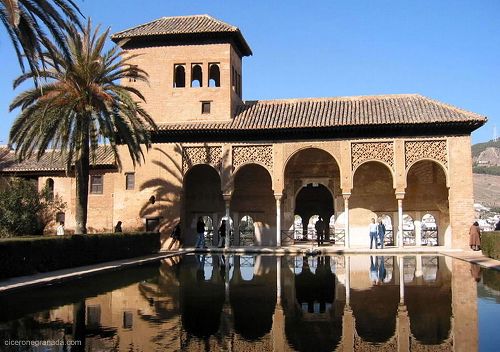
A completely different atmosphere dominates the Court of the Myrtles (*Patio de los Arrayanes*). This is an expression of power. Here, ambassadors could parade with their retinues, or subjects could present petitions to the Sultan. If we look at the Court of the Myrtles today, we find a double surprise: it remains remarkably faithful to its history, yet it appears designed by a minimalist landscape architect.
It looks like a 21st-century garden—a white marble rectangle containing three green rectangles: two of myrtle and one of water. This simplicity and cleanliness of elements seem like the work of a modern architect, yet they are the product of history itself.
The courtyard is not merely an empty space, but a core part of the architectural program, with water as its central element. Through the reflection in the pool, the palace is multiplied. The horizontal axis is cut, and the vertical reflection creates a sense of sublime scale. The fine ripples of the water produced moving reflections, while the light changed as the sun moved, shifting the depth of the space.
Water was essential throughout the Alhambra, serving three functions: as an architectural element, as a spiritual symbol, and as a means of comfort and climate control. Water is fundamental to the practice of Islam and, of course, to the growth of a palatine city with all the power such an enclosure implies.
Efforts are currently underway to recover interesting hydraulic elements such as canals, wells, irrigation pools, and water distribution wheels (*norias*).
Hydraulic System and Irrigation
Water distribution in the Alhambra was based on a complex system of streams, canals, reservoirs, underground pipes, pools, and fountains. Water was drawn from the Darro River more than 6 km away. The *Acequia Real* (Royal Canal) ran parallel to the riverbed, eventually leading water to the *Cerro del Sol*. From there, a water wheel (*noria*) transported water from a well to a reservoir. Near the well, archaeologists have discovered circular tracks, likely left by the donkeys used to power the wheel. These reservoirs were situated above the Alhambra to provide the necessary gravity-fed pressure.
Kilometers of canals supplied the courtyards, gardens, homes, and baths. Streams irrigated the terraces, orchards, and pleasure gardens. The *Acequia Real* passed directly through the Generalife Palace—a perfect synthesis of functionality and aesthetics. The water staircase served for recreation but was also functional as a distribution channel.
In the outer fortified ring of the Alhambra, an aqueduct supplied the entire complex with water. This was a delicate point—the Achilles' heel of the fortress in case of an attack.
The Court of the Lions
Water is also the central element in the Palace of the Lions. The Nasrids called it the "Happy Garden." Because of this, there has been a lively debate since the beginning of the century: were the four parterres originally paved, or were they sunken gardens?
The four channels are often seen as symbolic of the four rivers of Paradise. Today, we know these channels date from the modern era. All channels flow to the center, to the Fountain of the Lions—12 statues that spout water through an ingenious system that keeps the water level in the basin constant.
The lions may appear identical, but they are not. The sculptor carefully chose marble blocks to reproduce wrinkles and fur in a plastic, realistic way, preserved today through meticulous restoration. The exact origin of the lions is unknown, though an 11th-century poem describes similar figures in a nearby palace. What is clear is that they are a symbol of power. Their tense posture makes them appear alert, as if they might spring at the Sultan’s command.
The fountain’s basin—a circle in the middle of the garden—is once again a geometric figure recreating the universe. Carved on the exterior of the basin is Ibn Zamrak’s most famous poem: "Blessed be He who gave the Imam Mohamed the beautiful ideas to adorn his mansions... In appearance, water and marble seem to merge, and we know not which of the two flows. Do you not see how the water spills into the basin, yet the pipes hide it immediately? It is a lover whose eyelids overflow with tears... It is like a white cloud pouring its channels into the lions..."
Climate Control and Comfort
The channels connect the four rooms around the courtyard. Fountains set in the marble floor cool and refresh the temperature. The walls have no windows at the lower level, so hot air rises and escapes through the upper lattices like a chimney. Thanks to this, the temperature in the wings remains pleasant in summer, even when outside temperatures reach 40 degrees Celsius in the shade. This effect is also achieved through the optimal distribution of buildings: in summer, the main rooms are shaded, while in winter, the lower sun warms the chambers.
The unity between architecture and nature, the flexible use of the wings, and the optimal use of natural resources are principles of a past culture that serve as a model for future generations.
Materials and Techniques
The Nasrid reign was perpetually under threat, and its economy was rarely characterized by abundance. Thus, it is striking what the architects of the Alhambra achieved with humble means: adobe, wood, plaster, and local materials are the primary components of the entire citadel.
From the Babylonians and Egyptians to the Greeks and Romans, architects have long valued the advantages of plaster (gypsum). It is easy to source and manipulate; yet, nowhere else were ornaments created that were as refined and functional as those in the Alhambra.
Production and Restoration
In the 14th and 15th centuries, the Nasrids began the mass production of ornaments. Previously, it was common to carve plaster decorations directly onto the walls. They began using molds and templates for printing and casting, which allowed for a significant improvement in the quality and complexity of the motifs—a major technological leap. Restoring these fine ornaments requires specialized knowledge and high levels of competence. Today, it is difficult to determine which decorative elements are original and which were modified over the centuries.
Furthermore, plaster appears on the requisition lists of the Catholic Monarchs, indicating that immediately after the conquest of the Alhambra, repairs were made or new ornaments were created in imitation of Nasrid art. However, the Christian inhabitants did not trust the local expertise of the Muslims, so they brought a master plasterer from Zaragoza. In March 1492, he took up his post along with two apprentices.
In the 19th century, systematic restoration work finally began. However, restorers gave free rein to their own aesthetic concepts; for example, they attempted to hide the seams between the new plaster plates and the old ones. To do this, they brushed all surfaces with a brown liquid, causing the original vibrant colors to lose their effect. The restorers were attempting to "recreate" a centuries-old patina.
Today, that brown paint can still be seen on walls that, in the Sultan’s time, were bright white with colorful accents. With the help of ultraviolet light, experts can now identify which areas have been retouched. Nasrid artisans also demonstrated mastery over wood. The ceiling of the *Mirador de Lindaraja* is the only one of its kind preserved today. It gives us an idea of how most windows in the Alhambra once looked. Restoring the wooden frames with their colored glass is a three-dimensional puzzle, much like the hydraulic system of the Court of the Lions.
Restoration involves a wide array of experts: archaeologists, art historians, architects, and conservators. Only through teamwork and scientific meticulousness can the traces of the Nasrid legacy be rescued. Nevertheless, over time, some ornaments and complete architectural elements have been lost—primarily because past restorers did not always safeguard the true history of the works. The most famous example of this was the controversy over the dome in the Court of the Lions. In the 19th century, the French architect Eugène Viollet-le-Duc led the field of restoration with a profound knowledge of ancient techniques; however, his priority was not historical preservation but "resurrecting" a work in its "ideal" characteristic style. Whatever did not fit this perceived style was removed.
This model influenced an entire era, including the restorers of the Alhambra. They invented an idealized "Oriental" style. In 1859, they placed a small dome with ceramic tiles over a pavilion in the Court of the Lions, believing it matched the style of the "East." Naturally, they were slaves to their time and created a "Romantic Alhambra." This temple had an air that was half-Turkish, half-Persian, and somewhat Hindu. It eventually became evident that this "Oriental cap" made no historical sense. These observations were recorded by the famous Arabist Emilio García Gómez.
Scientific Restoration
In 1923, Leopoldo Torres Balbás was appointed the curator-architect of the Alhambra. He made a controversial decision: to restore the pavilion to its original appearance by tearing down the Romantic dome. It was a scandal. Newspapers in London, Berlin, and Paris reported on this "incredible" act. A new line of thought emerged from Torres Balbás: it would no longer be Romantic fantasies that determined the restoration of the Alhambra, but scientific criteria and respect for the unique originals.
All of Granada was plunged into indignant debate. Many had grown accustomed to their "beautiful and romantic" Alhambra and accused the new restorer of ruining it. Today, humanity benefits from the knowledge experts have acquired here regarding the physical realities of the site—distinguishing between the white plaster of the originals and the black plaster often used for later repairs.
Outreach and Cultural Legacy
The Alhambra involves not only the work of conservation but also of outreach—spreading the spirit of what it represents. In this sense, activities are oriented toward the idea that conserving heritage means leaving it for future generations so they can continue to enjoy it. Educational programs aim to promote the understanding of other cultures. Direct contact with history awakens curiosity about different ways of life and expression.
The Alhambra and the Generalife are living monuments. The famous Granada International Festival of Music and Dance is held annually within the monumental grounds. The Nasrid Palaces and their gardens host musicians and artists from around the world in a sensory festival with a spectacular stage.
If Granada is an international city, it is largely thanks to the Alhambra.
Perhaps because it is a unique place and because this legacy has been preserved over time, it can today be enjoyed by the millions of people who visit us every year.
It is indeed a symbol that defines us, but I also believe it symbolizes something very special for the country. Through an intelligent and comprehensive reading of what the Alhambra represents, we encounter a rich past—a history of the fusion of civilizations. It is a past that we must understand today through the lens of coexistence (*convivencia*), which is so necessary.
.JPG)